Mammalia |
Cetartiodactyla |
Balaenopteridae
環境:環境 / 気候帯 / 深さの範囲 / 分布範囲
生態学
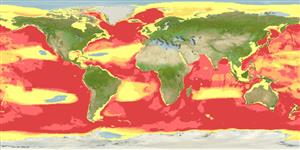
外洋の; 海洋回遊性 (参照 75906); 深さの範囲 80 - 500 m (参照 1005). Polar; 90°N - 90°S, 180°W - 180°E
North Atlantic and North Pacific: Balaenoptera musculus musculus.
North Atlantic [IUCN 2010 (Ref. 84930): VU, D1] and North Pacific [IUCN 2010 (Ref. 84930): LR/cd.
初回成熟時の長さ / サイズ / 重さ / 年齢
成熟: Lm ? range ? - ? cm Max length : 3,300 cm TL オス/雌雄の選別がない; (参照 99323); 最大公表体重: 160.0 t (参照 1394)
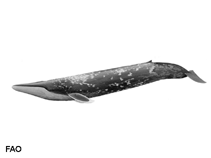
The largest whales of the world's oceans. They can be seen from the equator to the pack ice edges in both hemispheres, with most poleward intrusions in both hemispheres in summer. Some are resident, others are migratory. Feeds on krill (Ref. 1394). Feeds at depths less than 100 m (Ref. 1005). From the time faster catcher boats and explosive harpoons made them catchable, blue whales were hunted relentlessly from the late 19th through the mid 20th centuries. As the largest whales, they were the most sought after of the rorquals. Although most populations remain well below pre-exploitation levels, some stocks (such as those that feed off California) have shown encouraging signs of recovery since protection by the International Whaling Commission (IWC) in 1965. At least in the eastern North Atlantic and the eastern North Pacific, numbers appear to be on the rise (Ref. 1394). In general, they occur in coastal, shelf, and oceanic waters (Ref. 122680). They can be seen from the equator to the pack ice edges in both hemispheres, with most poleward intrusions in both hemispheres in summer. Some are resident, others are migratory (Ref. 1394). Known as 'gulpers,' feeding in separate events, often lunging at large schools of fish (Ref. 122680). Feeds on krill (Ref. 1394). Feeds at depths less than 100 m (Ref. 1005).
ライフサイクルと交尾行動
成熟 | 繁殖 | 放精 | 卵 | 生産力 | 幼生
主な参考文献
参考文献 | コーディネーター | 協力者
Jefferson, T.A., S. Leatherwood and M.A. Webber 1993 FAO species Identification Guide: Marine Mammals of the World. Rome, FAO. 320 p. + 587 figures. (参照 1394)
IUCNのレッドリストの状況は
(参照 130435: Version 2025-2 (Global))
絶滅危惧 (EN) (A1abd); Date assessed: 16 March 2018
ワシントン条約ステータス (参照 108899)
人間に対する脅威
人間の用途
水産業: 商業
FAO - 水産業: 種の外形, landings search; Publication: search | FishSource | 私達の周りの海
用具
インターネットの情報源
モデルに基づく推定値
回復力
(Ref. 69278): |
低い, 4.5年~14年の倍増期間の最小個体群 (K=0.08-0.09; tm=11) |
漁業の脆弱性
(参照 71543) |
Very high vulnerability (84 of 100). |
価格帯
(参照 80766): |
Unknown. |