Mammalia |
Cetartiodactyla |
Balaenopteridae
Ambiente: milieu / zona climática / intervalo de profundidade / gama de distribuição
Ecologia
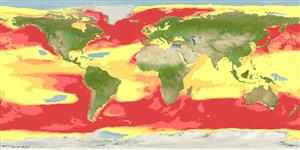
Pelágico(a,os,as); oceanódromo (Ref. 75906); intervalo de profundidade 0 - 528 m (Ref. 137921). Tropical; 90°N - 90°S, 180°W - 180°E
Circumglobal: Balaenoptera physalus physalus: Svalbard, Barents Sea, North Carolina, Portugal, Cantabrian Sea, Newfoundland, Gulf of Mexico, Greater Antilles, Faroe Islands, Norway, Canary Islands, Sea of Okhotsk, Kuril Islands, Bering Sea, Chukchi Sea, Gulf of Alaska, Sea of Japan, Japan, Taiwan, Ogasawara, Hawaii, California, Baja California, Gulf of California; Balaenoptera physalus quoyi: Ross Ice Shelf, Brazil, Gabon, Angola, Namibia, South Africa, Madagascar, Western Australia, New Zealand, Colombia, Peru, Chile (Ref. 1522).
Comprimento na primeira maturidade / Tamanho / Peso / Idade
Maturidade: Lm ? range ? - ? cm Max length : 2,700 cm TL macho/indeterminado; (Ref. 1394); peso máx. Publicado: 75.0 t (Ref. 1394)
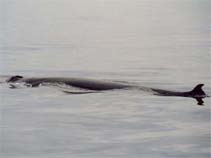
The largest of the fin whales. Seen near shore, most commonly where deep water approaches the coast. Feeds on small invertebrates, schooling fishes, and squid. They are active lunge feeders (Ref. 1394). They are preyed upon by great white sharks (Ref. 32140). Following depletion of blue whale stocks, whalers shifted their attention to fin whales. Populations everywhere were substantially reduced. At present the worldwide population does not seem to appear in any immediate danger (Ref. 1394). Minimum depth from Ref. 116169. Seen near shore, most commonly where deep water approaches the coast (Ref. 1394). Commonly in groups of 2 to 7 individuals (Ref. 801). Feeds on small I krill (Ref. 122680), invertebrates, schooling fishes, and squid. They are active lunge feeders (Refs. 1394, 122680).
Ciclo de vida e comportamento de acasalamento
Maturidade | Reprodução | Desova | Ovos | Fecundidade | Larvas
Jefferson, T.A., S. Leatherwood and M.A. Webber 1993 FAO species Identification Guide: Marine Mammals of the World. Rome, FAO. 320 p. + 587 figures. (Ref. 1394)
Categoria na Lista Vermelha da IUCN
(Ref. 130435: Version 2025-2 (Global))
Categoria CITES (Ref. 108899)
Ameaça para o homem
Utilização humana
Pescarias: espécies comerciais
FAO - pescarias: perfil da espécie, landings search; Publication: search | FishSource | Sea Around Us
Ferramentas
Mais informação
FisiologiaConsumo de oxigénio
Relacionado com o ser humanoSelos, moedas, diversos.
Fontes da internet
Estimativas baseadas em modelos
Resiliência
(Ref. 69278): |
Médio, tempo mínimo de duplicação da população 1,4 - 4,4 anos (K=0.25-0.27; tm=17.5) |
Vulnerabilidade da pesca
(Ref. 71543) |
Very high vulnerability (76 of 100). |
Categoria de preço
(Ref. 80766): |
Unknown. |