Mammalia |
Cetartiodactyla |
Balaenopteridae
Environnement : milieu / zone climatique / profondeur / gamme de distribution
Écologie
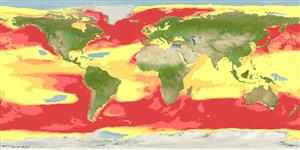
Pélagique; océanodrome (Réf. 75906); profondeur 0 - 528 m (Réf. 137921). Tropical; 90°N - 90°S, 180°W - 180°E
Circumglobal: Balaenoptera physalus physalus: Svalbard, Barents Sea, North Carolina, Portugal, Cantabrian Sea, Newfoundland, Gulf of Mexico, Greater Antilles, Faroe Islands, Norway, Canary Islands, Sea of Okhotsk, Kuril Islands, Bering Sea, Chukchi Sea, Gulf of Alaska, Sea of Japan, Japan, Taiwan, Ogasawara, Hawaii, California, Baja California, Gulf of California; Balaenoptera physalus quoyi: Ross Ice Shelf, Brazil, Gabon, Angola, Namibia, South Africa, Madagascar, Western Australia, New Zealand, Colombia, Peru, Chile (Ref. 1522).
Longueur à la première maturité / Taille / Poids / Âge
Maturité: Lm ? range ? - ? cm Max length : 2,700 cm TL mâle / non sexé; (Réf. 1394); poids max. publié: 75.0 t (Réf. 1394)
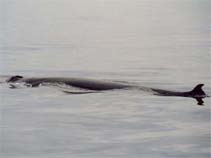
The largest of the fin whales. Seen near shore, most commonly where deep water approaches the coast. Feeds on small invertebrates, schooling fishes, and squid. They are active lunge feeders (Ref. 1394). They are preyed upon by great white sharks (Ref. 32140). Following depletion of blue whale stocks, whalers shifted their attention to fin whales. Populations everywhere were substantially reduced. At present the worldwide population does not seem to appear in any immediate danger (Ref. 1394). Minimum depth from Ref. 116169. Seen near shore, most commonly where deep water approaches the coast (Ref. 1394). Commonly in groups of 2 to 7 individuals (Ref. 801). Feeds on small I krill (Ref. 122680), invertebrates, schooling fishes, and squid. They are active lunge feeders (Refs. 1394, 122680).
Cycle de vie et comportement reproducteur
Maturité | Reproduction | Frai | Œufs | Fécondité | Larves
Jefferson, T.A., S. Leatherwood and M.A. Webber 1993 FAO species Identification Guide: Marine Mammals of the World. Rome, FAO. 320 p. + 587 figures. (Réf. 1394)
Statut dans la liste rouge de l'IUCN
(Réf. 130435: Version 2025-2 (Global))
statut CITES (Réf. 108899)
Menace pour l'homme
Utilisations par l'homme
Pêcheries: commercial
FAO - pêcheries: Résumé espèce, landings search; Publication: search | FishSource | Sea Around Us
Outils
Plus d'informations
Dynamique des populations PhysiologieConsommation d'oxygène
Liées à l'hommeTimbres, pièces de monnaie, divers
Sources Internet
Estimations basées sur des modèles
Résilience
(Ref. 69278): |
Milieu, temps minimum de doublement de population : 1,4 à 4,4 années (K=0.25-0.27; tm=17.5) |
Vulnérabilité de la pêche
(Réf. 71543) |
Very high vulnerability (76 of 100). |
Catégorie de prix
(Réf. 80766): |
Unknown. |