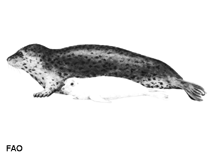
Mammalia |
Carnivora |
Phocidae
Umwelt: Milieu / Klimazone / Tiefenbereich / Verbreitungsgebiet
Ökologie
Bathydemersal. Subtropical; 90°N - 0°S, 126°E - 115°W
Pacific Ocean and the Arctic: Eastern side of Ostrov Sakhalin to northern Hokkaido. Subtropical to polar.
Länge bei der ersten Reifung / Größe / Gewicht / Alter
Geschlechtsreife: Lm ? range ? - ? cm Max length : 170 cm TL Männchen/unbestimmt; (Ref. 1394); 160 cm TL (female); max. veröff. Gewicht: 123.0 kg (Ref. 1394)
Inhabit the southern edges of the pack ice from winter to early summer and coastal areas including river mouths, in late summer and autumn. Diet composition varies with the age of the seal; Newly weaned pups feed on small crustaceans, advance to schooling fishes, larger crustaceans, and octopuses, and finally graduate to bottom dwelling fish and cephalopods (Ref. 1394). Inhabits the southern edges of the pack ice from winter to early summer and coastal areas including river mouths, in late summer and autumn. Diet composition varies with the age of the seal; newly weaned pups feed on small crustaceans, advance to schooling fishes, larger crustaceans, and octopuses, and finally graduate to bottom dwelling fish and cephalopods (Ref. 1394). Those in their first year tend to eat mostly small crustaceans, algae, sticks and debris; 1 to 4 year olds mostly eat fishes, larger shrimps, and octopus, occasionally; 5 year olds consumed more benthic invertebrates like crabs and octopus (Ref. 119414).
Lebenszyklus und Paarungsverhalten
Geschlechtsreife | Fortpflanzung | Ablaichen | Eier | Fruchtbarkeit | Larven
Jefferson, T.A., S. Leatherwood and M.A. Webber 1993 FAO species Identification Guide: Marine Mammals of the World. Rome, FAO. 320 p. + 587 figures. (Ref. 1394)
IUCN Rote Liste Status
(Ref. 130435: Version 2025-2 (Global))
CITES Status (Ref. 108899)
Not Evaluated
Not Evaluated
Bedrohung für Menschen
Nutzung durch Menschen
Fischereien: kommerziell
FAO - Fischereien: Artbeschreibung, landings search; Publication: search | FishSource | Das Meer um uns herum
Tools
Mehr Information
LebenszyklusFortpflanzungGeschlechtsreifeFruchtbarkeitAblaichenEierEientwicklungLarven PhysiologieSauerstoffverbrauch
MenschenbezogenBriefmarken, Münzen, Verschiedenes.
Internet Quellen
Schätzungen auf der Grundlage von Modellen
Widerstandsfähigkeit
(Ref. 69278): |
mittel, Verdopplung der Population dauert 1,4 - 4,4 Jahre. (K=0.16-0.44) |
Anfälligkeit der Fischerei
(Ref. 71543) |
High to very high vulnerability (72 of 100). |
Preiskategorie
(Ref. 80766): |
Unknown. |