Reptilia |
Crocodilia |
Crocodylidae
Môi trường: môi trường / vùng khí hậu / Mức độ sâu / phạm vi phân phối
Sinh thái học
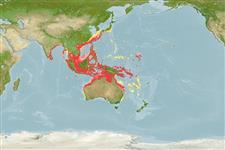
Tầng nổi; Ở đại duơng, biển (Tài liệu tham khảo 77091); nước ngọt; mức độ sâu 0 - 200 m. Tropical; 41°N - 36°S, 77°E - 171°E (Tài liệu tham khảo 356)
Indo-West Pacific.
Chiều dài lúc trưởng thành đầu tiên / Bộ gần gũi / Khối lượng (Trọng lượng) / Tuổi
Chín muồi sinh dục: Lm 110.0 range ? - ? cm Max length : 615 cm TL con đực/không giới tính; (Tài liệu tham khảo 77094)
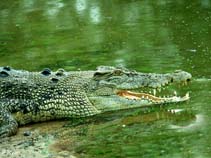
Large head and strong snout with a pair of ridges bridging the orbits. Uniform dorsal scales. Very variable coloration. Juveniles with black bands and spots. Body with 4-5 black bands which may disappear in very large individuals. The belly is uniformly colored beige to golden yellow. Some individuals maybe highly pigmented.
May cross open ocean as evidenced by occurrence in remote islands in the Indian Ocean and in the western Pacific Ocean (salinity range 5-20 per mille). Inhabits a wide range of habitats (rivers, creeks, swamps, lagoons and billabongs); needs a source of water less salty than their blood (blood plasma salinity of 11per mille). Ref. 77096 reports a maximum length of 700 cm total length and a maximum weight of 1000 kg for captive individuals. Often basks on open mud banks in cooler months and often in the shade of mangrove areas in warmer months. Has a strong homing ability. Oceanodromous individuals may have barnacles attached to their scales (Ref. 77096). May also have endoparasites, i.e., round worms, tongue worms and flukes (Ref. 77091). Crocodile eggs and flesh are food for humans, while crocodile skin (notably near the belly) are used by the leather industry mostly from farmed crocodiles (Ref. 77091). Known to attack humans, sometimes fatally (Ref. 077096, 077099). Active throughout the year. Hunts by day and night; hunting probably associated to diving behavior. Size determines feeding, i.e., small crocodiles feed frequently on small prey items while larger crocodiles feed infrequently on larger prey. May consume carrion. Gastroliths (stomach stones) help in digesting food items (Ref. 77091).
Vòng đời và hành vi giao phối
Chín muồi sinh dục | Sự tái sinh sản | Đẻ trứng | Các trứng | Sự sinh sản | Ấu trùng
Greer, A.E. 2006 Encyclopedia of Australian reptiles - Crocodylidae. Australian Museum Online. [http://www.amonline.net.au/herpetology/research/encyclopedia.pdf Version date: 7 August 2006, accessed 16 July 2008]. (Tài liệu tham khảo 77091)
Tình trạng Sách đỏ IUCN
(Tài liệu tham khảo 130435: Version 2025-2 (Global))
tình trạng CITES (Tài liệu tham khảo 108899)
CMS (Tài liệu tham khảo 116361)
Mối đe dọa đối với con người
Traumatogenic (Tài liệu tham khảo 77096)
Sử dụng của con người
Các nghề cá: tính thương mại; Nuôi trồng thủy sản: tính thương mại
FAO - Các nghề cá: landings search; Publication: search | FishSource | Biển chung quanh ta
Các công cụ
Thêm thông tin
Sinh lý họcThành phần ô-xy
Liên quan đến con ngườiTem, tiền xu, v.v.
Các nguồn internet
Ước tính dựa trên mô hình
Thích nghi nhanh
(Ref. 69278): |
Chiêù cao, thời gian nhân đôi của chủng quần tối thiểu là dưới 15 tháng (K=0.71-2.5) |
Sự dễ bị tổn thương của nghề đánh cá
(Tài liệu tham khảo 71543) |
Moderate to high vulnerability (50 of 100). |
Loại giá
(Tài liệu tham khảo 80766): |
Unknown. |