Reptilia |
Crocodilia |
Crocodylidae
Lingkungan: lingkungan / zona iklim / kisaran kedalaman / jangkauan distribusi
Ekologi
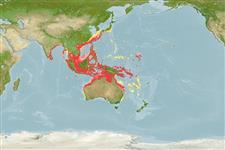
Pelagis, permukaan; oceanodromus (Acuan 77091); air tawar; kisaran kedalaman 0 - 200 m. Tropical; 41°N - 36°S, 77°E - 171°E (Acuan 356)
Indo-West Pacific.
Panjang pada saat jatuh tempo pertama / Ukuran / Berat / umur
Kematangan: Lm 110.0 range ? - ? cm Max length : 615 cm TL jantan/; (Acuan 77094)
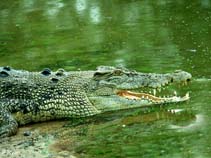
Large head and strong snout with a pair of ridges bridging the orbits. Uniform dorsal scales. Very variable coloration. Juveniles with black bands and spots. Body with 4-5 black bands which may disappear in very large individuals. The belly is uniformly colored beige to golden yellow. Some individuals maybe highly pigmented.
May cross open ocean as evidenced by occurrence in remote islands in the Indian Ocean and in the western Pacific Ocean (salinity range 5-20 per mille). Inhabits a wide range of habitats (rivers, creeks, swamps, lagoons and billabongs); needs a source of water less salty than their blood (blood plasma salinity of 11per mille). Ref. 77096 reports a maximum length of 700 cm total length and a maximum weight of 1000 kg for captive individuals. Often basks on open mud banks in cooler months and often in the shade of mangrove areas in warmer months. Has a strong homing ability. Oceanodromous individuals may have barnacles attached to their scales (Ref. 77096). May also have endoparasites, i.e., round worms, tongue worms and flukes (Ref. 77091). Crocodile eggs and flesh are food for humans, while crocodile skin (notably near the belly) are used by the leather industry mostly from farmed crocodiles (Ref. 77091). Known to attack humans, sometimes fatally (Ref. 077096, 077099). Active throughout the year. Hunts by day and night; hunting probably associated to diving behavior. Size determines feeding, i.e., small crocodiles feed frequently on small prey items while larger crocodiles feed infrequently on larger prey. May consume carrion. Gastroliths (stomach stones) help in digesting food items (Ref. 77091).
Siklus hidup dan perilaku kawin
Kematangan | Reproduksi, perkembang biakan | Pemijahan | telur-telur | Fekunditas | Larva
rujukan utama
Acuan | Koordinator | mitra
Greer, A.E. 2006 Encyclopedia of Australian reptiles - Crocodylidae. Australian Museum Online. [http://www.amonline.net.au/herpetology/research/encyclopedia.pdf Version date: 7 August 2006, accessed 16 July 2008]. (Acuan 77091)
Status IUCN Red List
(Acuan 130435: Version 2025-2 (Global))
status CITES (Acuan 108899)
ancaman kepada manusia
Traumatogenic (Acuan 77096)
penggunaan manusia
Perikanan: komersial; Budidaya air: komersial
FAO - Perikanan: landings search; Publication: search | FishSource | Laut di Sekitar Kita
Alat, peralatan
informasi lanjut
FisiologiKonsumsi oksigen
Yang berhubungan dengan manusiaPerangko, koin, dll.
Sumber internet
Estimasi berdasarkan model
Daya lenting
(Ref. 69278): |
Tinggi, Waktu penggandaan populasi minimum kurang dari 15 bulan (K=0.71-2.5) |
Kerentanan Penangkapan Ikan
(Acuan 71543) |
Moderate to high vulnerability (50 of 100). |
kategori harga
(Acuan 80766): |
Unknown. |