Not assigned |
Testudines |
Cheloniidae
Ambiente: milieu / zona climatica / distribuzione batimetrica / gamma di distribuzione
Ecologia
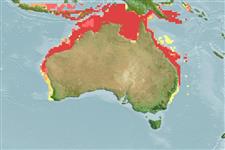
Benthopelagico; distribuzione batimetrica 0 - 200 m (Fonte Biblio. 1397). Tropical; 6°S - 38°S, 109°E - 157°E (Fonte Biblio. 1397)
Indo-West Pacific: endemic to Australia.
Lunghezza alla prima maturità / Dimensione / Peso / Età
Maturità: Lm ? range ? - ? cm Max length : 96.0 cm CL maschio/sesso non determinato; (Fonte Biblio. 1397); peso massimo pubblicato: 84.0 kg (Fonte Biblio. 1397)
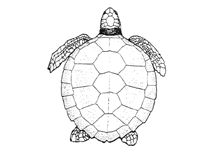
Adult: body flat, and carapace smooth, nearly elliptical with upturned margins. In subadults: carapace rim indented from middle to the back. Head: medium-sized, subtriangular, flat on top. Snout: longer and nearly equal to orbit. Scutes: ventrally consists of 6 pairs of main scutes, one intergular scute, a pair of postanal scutes and 4 poreless inframarginal scutes
in each bridge with only one axillary scale in each bridge. Single visible claw in each flipper. Color: adults dorsally dull olive-grey with pale brownish yellow
tones marginally; neck and head pale tone. Plastron ventrally are creamy white. Young individuals: brightly colored. Hatchlings: carapace scutes form a dark grey reticulate pattern; each scute are pale olive green; carapace rim and flippers are cream-colored band. Ventrally cream-white, except central part of each flipper which is bluish-grey diffuse spot.
This species inhabits the shallow waters especially on coral reef areas like Great Barrier Reef and continental islands. Nesting only takes place in Australia. The peak season varies in localities: in southeast Queensland, November to January; in northern beaches, occurs throughout the year with a peak between March and April. Renesting interval usually lasts from 12 to 23 days. The nesting cycle at Mon Repos, ranges from 1 to 5 years with a mean of 2.65 years. Used as a value for subsistence and for some people the meat is considered as poisonous that is why local consumption is low (Ref. 1397). Inhabits the shallow waters of Australia especially on coral reef areas like the Great Barrier Reef and continental islands (Ref. 1397). Clutch volume may be determined by the available space it has for carrying eggs which is influenced by the adult size and morphology (Ref. 81165). Feeds on benthic invertebrates and jellyfishes (Ref. 97534).
Ciclo vitale e comportamento di accoppiamento
Maturità | Riproduzione | Deposizione | Uova | Fecondità | Larve
Australia is the only place for nesting. The peak season varies in localities: in southeast Queensland, November to January; in northern beaches, occurs throughout the year with a peak between March and April. Renesting interval usually ranges from 12 to 23 days. The nesting cycle at Mon Repos, ranges from 1 to 5 years with a mean of 2.65 years (Ref. 1397). Temperature-dependent Sex Determination (TSD) is demonstrated in this species (Ref. 83973).
Hirth, H.F. 1993 Chapter 10. Marine turtles. pp. 329-370. In A. Wright and L. Hill (eds) Nearshore marine resources of the South Pacific. Forum Fisheries Agency (Honiara), Institute of Pacific Studies (Suva) and International Centre for Ocean Development (Canada), 710 p. (Fonte Biblio. 97534)
Stato della Lista Rossa IUCN
(Fonte Biblio. 130435: Version 2025-2 (Global))
Stato della CITES (Fonte Biblio. 108899)
CMS (Fonte Biblio. 116361)
Minaccia per l'uomo
Poisonous to eat
Usi umani
Pesca: pesca di sussistenza
FAO - Publication: search | FishSource | Sea Around Us
Strumenti
Informazioni ulteriori
Dinamica della popolazione FisiologiaConsumo di ossigeno
Legato all'uomoFrancobolli, monete, materiale vario.
Fonti Internet
Stime basate su modelli
Resilienza
(Ref. 69278): |
Basso, tempo minimo di raddoppiamento della popolazione 4.5 - 14 anni (K=0.07-0.1) |
Vulnerabilità della pesca
(Fonte Biblio. 71543) |
High vulnerability (58 of 100). |
Categoria di prezzo
(Fonte Biblio. 80766): |
Unknown. |