Not assigned |
Testudines |
Cheloniidae
Περιβάλλον: περιβάλλον / κλιματική ζώνη / εύρος βάθους / εύρος διανομής
Οικολογία
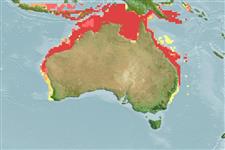
βενθοπελαγικό; εύρος βάθους 0 - 200 m (Αναφ. 1397). Tropical; 6°S - 38°S, 109°E - 157°E (Αναφ. 1397)
Indo-West Pacific: endemic to Australia.
Μήκος κατά την πρώτη ωρίμανση / Μέγεθος / Βάρος / Ηλικία
Γεννητική Ωρίμανση: Lm ? range ? - ? cm Max length : 96.0 cm CL αρσενικό/απροσδιόριστο; (Αναφ. 1397); μεγ. δημοσιευμένο βάρος: 84.0 kg (Αναφ. 1397)
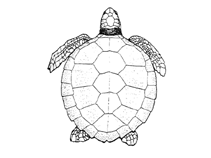
Adult: body flat, and carapace smooth, nearly elliptical with upturned margins. In subadults: carapace rim indented from middle to the back. Head: medium-sized, subtriangular, flat on top. Snout: longer and nearly equal to orbit. Scutes: ventrally consists of 6 pairs of main scutes, one intergular scute, a pair of postanal scutes and 4 poreless inframarginal scutes
in each bridge with only one axillary scale in each bridge. Single visible claw in each flipper. Color: adults dorsally dull olive-grey with pale brownish yellow
tones marginally; neck and head pale tone. Plastron ventrally are creamy white. Young individuals: brightly colored. Hatchlings: carapace scutes form a dark grey reticulate pattern; each scute are pale olive green; carapace rim and flippers are cream-colored band. Ventrally cream-white, except central part of each flipper which is bluish-grey diffuse spot.
This species inhabits the shallow waters especially on coral reef areas like Great Barrier Reef and continental islands. Nesting only takes place in Australia. The peak season varies in localities: in southeast Queensland, November to January; in northern beaches, occurs throughout the year with a peak between March and April. Renesting interval usually lasts from 12 to 23 days. The nesting cycle at Mon Repos, ranges from 1 to 5 years with a mean of 2.65 years. Used as a value for subsistence and for some people the meat is considered as poisonous that is why local consumption is low (Ref. 1397). Inhabits the shallow waters of Australia especially on coral reef areas like the Great Barrier Reef and continental islands (Ref. 1397). Clutch volume may be determined by the available space it has for carrying eggs which is influenced by the adult size and morphology (Ref. 81165). Feeds on benthic invertebrates and jellyfishes (Ref. 97534).
Κύκλος ζωής και συμπεριφορά ζευγαρώματος
Γεννητική Ωρίμανση | Αναπαραγωγή | Γεννοβολία | Αβγά | Γονιμότητα | Προνύμφες
Australia is the only place for nesting. The peak season varies in localities: in southeast Queensland, November to January; in northern beaches, occurs throughout the year with a peak between March and April. Renesting interval usually ranges from 12 to 23 days. The nesting cycle at Mon Repos, ranges from 1 to 5 years with a mean of 2.65 years (Ref. 1397). Temperature-dependent Sex Determination (TSD) is demonstrated in this species (Ref. 83973).
Hirth, H.F. 1993 Chapter 10. Marine turtles. pp. 329-370. In A. Wright and L. Hill (eds) Nearshore marine resources of the South Pacific. Forum Fisheries Agency (Honiara), Institute of Pacific Studies (Suva) and International Centre for Ocean Development (Canada), 710 p. (Αναφ. 97534)
Κατάσταση Κόκκινου Καταλόγου IUCN
(Αναφ. 130435: Version 2025-2 (Global))
Καθεστώς CITES (Αναφ. 108899)
Απειλή για τον άνθρωπο
Poisonous to eat
Ανθρώπινες χρήσεις
αλιεία: παραδοσιακή αλιεία
FAO - Publication: search | FishSource | Η θάλασσα γύρω μας
Εργαλεία
Περισσότερες πληροφορίες
Κύκλος ζωήςΑναπαραγωγήΓεννητική ΩρίμανσηΓονιμότηταΓεννοβολίαΑβγάΑνάπτυξη αυγώνΠρονύμφες ΦυσιολογίαΚατανάλωση οξυγόνου
Ανθρώπινη σχέσηΓραμματόσημα, νομίσματα, διάφορα.
Διαδικτυακές πηγές
Εκτιμήσεις βάσει μοντέλων
Ελαστικότητα
(Ref. 69278): |
Χαμηλό, ελάχιστος χρόνος για διπλασιασμό πληθυσμού 4,5 - 14 έτη (K=0.07-0.1) |
Ευπάθεια στην αλιεία
(Αναφ. 71543) |
High vulnerability (58 of 100). |
Κατηγορία τιμής
(Αναφ. 80766): |
Unknown. |