Not assigned |
Testudines |
Cheloniidae
Environnement : milieu / zone climatique / profondeur / gamme de distribution
Écologie
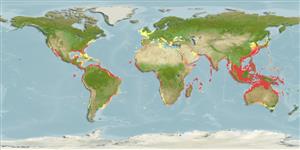
Benthopélagique; profondeur 0 - 200 m (Réf. 78527). Tropical; 61°N - 40°S, 130°W - 160°E (Réf. 1397)
Indo-Pacific and the Atlantic Ocean.
Longueur à la première maturité / Taille / Poids / Âge
Maturité: Lm ?, range 49 - ? cm Max length : 76.0 cm CL mâle / non sexé; (Réf. 418); common length : 75.0 cm CL mâle / non sexé; (Réf. 1397); poids max. publié: 43.4 kg (Réf. 1397)
Description synthétique
Morphologie
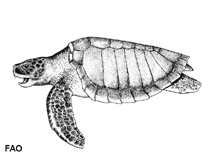
The olive ridley turtle has a slightly deeper body than the Kemp’s ridley. In adults; carapace nearly round; upturned on the lateral margins; flat on top; its width 90 percent of its length (Straight Curved Length (SCL)). Head: subtriangular; moderate-sized; averaging 22.4 percent of straight carapace length (SCL). Hatchlings: relatively bigger heads (39 percent SCL); longer carapaces (width 78 percent SCL); flippers comparatively bigger than in adults. In 3-year old juveniles: the carapace width, 93 percent of SCL; head length, 26 percent of SCL. Scales and scutes: same configuration as in the Kemp’s ridley; but the lateral scutes are often more than five pairs; the first pair is always in touch with the precentral scute. Also has openings of the Rathke’s glands on the plastral bridges; through a pore on the rear part of each inframarginal scute Fore flippers with 1 or 2 visible claws on the anterior border; sometimes another small claw in the distal part; rear flippers also with 2 claws. Males: larger more strongly curved claws; as well as a longer tail. Color: adults, plain olive-grey above; creamy or whitish; with pale grey margins underneath. Newborn hatchlings: when wet; almost completely black; sometimes with greenish sides; in general, become dark grey after drying. With growth; they change to grey dorsally and white underneath.
This species is the most abundant sea turtle in the world. Frequently neritic, usually migrates along the continental shelves and feeds in shallow waters (Ref. 1397) but also dives deeper than 150 m (Ref. 78527). Shallow coastal waters; open sea forming schools (Ref. 417). Habitat is a warm vertically stratified water with deep thermocline (Ref. 78527). Observed to be basking on sand beaches (Ref. 1397). Nesting patterns range from solitary to small groups to arribadas (Ref. 97534). Little information exists on the feeding behavior of post-hatchlings and juveniles in pelagic waters, but they are most likely exclusively carnivorous, consuming, for instance, invertebrates and fish eggs. Older juveniles and adults feed on a wide variety of benthic organisms (Ref. 122680).
Cycle de vie et comportement reproducteur
Maturité | Reproduction | Frai | Œufs | Fécondité | Larves
Mating occurs before and during nesting season near nesting beaches, along migratory routes or at the sea surface. When disturbed, they dive. It is assumed that promiscuity may occur but was not yet reported. Nesting season occurs in summer and autumn but varies from place to place. The reproductive cycle is almost annual which occurs every 14 or 28 days and repeats two to eight times per season. The mean number of eggs per clutch is around 109 eggs which usually ranges from a couple of dozen to more than 155 eggs. Incubation period extends from 45 to 65 days. Egg mean diameter ranges from 3.21 to 4.47 cm and 30 to 38 g in weight. Hatchlings ranges between 3.47 and 4.46 cm straight carapace length and from 12 to 22.3 g in body weight. Sizes and weight varies in different populations and localities (Ref. 1397). Temperature-dependent Sex Determination (TSD) is demonstrated in this species (Refs. 83974, 83976).
Hirth, H.F. 1993 Chapter 10. Marine turtles. pp. 329-370. In A. Wright and L. Hill (eds) Nearshore marine resources of the South Pacific. Forum Fisheries Agency (Honiara), Institute of Pacific Studies (Suva) and International Centre for Ocean Development (Canada), 710 p. (Réf. 97534)
Statut dans la liste rouge de l'IUCN
(Réf. 130435: Version 2025-2 (Global))
statut CITES (Réf. 108899)
Menace pour l'homme
Utilisations par l'homme
Pêcheries: commercial
FAO - Publication: search | FishSource | Sea Around Us
Outils
Plus d'informations
Dynamique des populations PhysiologieConsommation d'oxygène
Liées à l'hommeTimbres, pièces de monnaie, divers
Sources Internet
Estimations basées sur des modèles
Résilience
(Ref. 69278): |
Milieu, temps minimum de doublement de population : 1,4 à 4,4 années (K=0.14-0.18; tm=8) |
Vulnérabilité de la pêche
(Réf. 71543) |
High to very high vulnerability (70 of 100). |
Catégorie de prix
(Réf. 80766): |
Unknown. |