Not assigned |
Testudines |
Cheloniidae
Entorno: milieu / zona climática / rango de profundidad / gama de distribución
Ecología
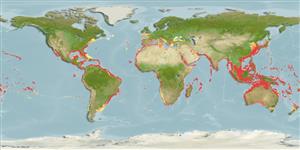
Asociado a arrecife; salobre; rango de profundidad 0 - 300 m (Referencia 102845). Tropical; 24°C - 31°C (Referencia 138175); 52°N - 56°S, 118°W - 124°W
Indo-Pacific and the Atlantic Ocean. Stray in the Mediterreanean Sea.
Longitud en la primera madurez / Tamaño / Peso / Edad
Madurez: Lm 50.0 range ? - ? cm Max length : 90.0 cm CL macho / no sexado; (Referencia 417); common length : 80.0 cm CL macho / no sexado; (Referencia 417); peso máximo publicado: 120.0 kg (Referencia 418)
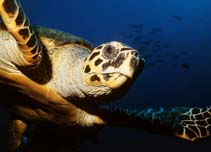
Carapace in adults: cardiform or elliptical; with imbricated dorsal scutes. Head: medium-sized; narrow; with a pointed beak; 2 pairs of prefrontal and 3 or 4 postorbital scales; tomium not serrated on the cutting edge; but hooked at the tip. Snout: narrow; elongated. Carapace scutes: thick for coping with waves; to obtain food from between corals and rocky substrates. Scutes: strongly imbricated at maturity. Scutelation of the carapace: similar to Chelonia, with 5 costal; 4 pairs of lateral (the first not touching the precentral scute); 11 pairs of marginal plus one pair of postcentral or pigal scutes. Plastron: covered by 5 pairs of scutes; plus one or two intergular; at times 1 small interanal. There are 4 poreless inframarginal scutes covering each bridge. Each rear and fore flipper bears 2 claws on its anterior border. Males: stronger, more curved claws and longer tails than females. Hatchlings and juveniles: wider carapace than adults. Carapace have 3 keels of spines which disappear with growth. Young adults: sometimes have a remnant of the dorsal central keel; without spines. In juveniles and subadults: scutes of the carapace are indented on the rear third of the carapace margin. Color: most colorful among sea turtles. In Eastern Pacific, pattern shows from very bright colors to the heavy melanistic forms. Scales of the head: creamy or yellow margins; more apparent at the sides or cheeks than on the roof. Carapace color: in spots or stripes; of the complementary colors: brown; red; black and yellow. Color spots and stripes: arranged in a fan-like pattern. Scutes underneath are thin and amber-colored; in juveniles, brown spots in the rear part of each scute. Head and flippers dorsal side: darker and less variable; in eastern Pacific population, the coloration is sometimes nearly black. Hatchlings: more homogeneous in color. At the rear part of the carapace, mostly brown with paler blotches on the scutes; and, also small pale spots on the 'tip' of each scute along the 2 keels of the plastron.
The most tropical of all sea turtles living in littoral waters. Turtles measuring up to 10 cm straight carapace length are usually nektonic animal. A carnivorous turtle commonly poking in crevices between rocks and corals; it becomes a regular inhabitant of hard substrata, i.e., corals, tunicates, algae and sponges. The duration of incubation lasts 47 to 75 days but varies depending on place and time. It is a high valued species in the international market (Ref. 1397). Most often seen in shallow waters around reefs, bays, and inlets (Ref. 122680). Turtles measuring up to 10 cm straight carapace length are usually nektonic animal. It changes to benthic feeding when it approaches coastal areas. This is a carnivorous turtle commonly poking in crevices between rocks and corals. It feeds on algae, ascidians, sponges, bryozoans, mollusks, hydroids, barnacles, cephalopods, salps, and seagrasses (Ref. 97534). It becomes a regular inhabitant of hard substrata, i.e., corals, tunicates, algae and sponges (Ref. 417). Associated with reef fishes (Ref. 104964) and a shrimp (Ref. 104967).
Commonly received attention from several males, polygamy. It has been observed that male holds the female by using its claws and tail while mating at shallow areas lasting for several hours. This species is considered to be a solitary nester which is confined between 25°N and 35°S. Nesting occurs mostly toward the end of spring throughout the summer with a nesting cycle of 2 or 3 years with a mean of 2.6 years. Renesting intervals lasts for 2 to 3 weeks with an average number of 2.3 clutches per season. The duration of incubation lasts 47 to 75 days but varies depending on place and time. Generally, hatchlings emerge when sand is below 28°C during the first hours of the night. They find their way rapidly to the surf zone and disappear for some time until they reach their age when they are mature enough to nest (Ref. 1397). Temperature-dependent Sex Determination (TSD) is demonstrated in this species (Refs. 83975, 83972, 83977). DNA samples from females and their offspring show that the number and which breeding males are involved can be identified. Female turtles mate at the beginning of the season, probably before migrating to nesting beaches and the sperm is stored for usage over the next couple of months. Each female mates with a different male showing that the their population is genetically viable (Ref. 92951).
Hirth, H.F. 1993 Chapter 10. Marine turtles. pp. 329-370. In A. Wright and L. Hill (eds) Nearshore marine resources of the South Pacific. Forum Fisheries Agency (Honiara), Institute of Pacific Studies (Suva) and International Centre for Ocean Development (Canada), 710 p. (Referencia 97534)
Situación en la Lista Roja de la UICN
(Referencia 130435: Version 2025-2 (Global))
Estatus CITES (Referencia 108899)
CMS (Referencia 116361)
Amenaza para el ser humano
Usos humanos
Pesquerías: muy comercial
FAO - pesquerías: perfil de la especie, landings search; Publication: search | FishSource | Sea Around Us
Herramientas
Más información
FisiologíaConsumo del oxígeno
Relacionados con el ser humanoSellos, monedas, varios
Fuentes de Internet
Estimaciones basadas en modelos
Resiliencia
(Ref. 69278): |
Bajo, población duplicada en un tiempo mínimo de 4.5-14 años (K=0.09-0.26; tm=3.5) |
Vulnerabilidad pesquera
(Referencia 71543) |
High vulnerability (57 of 100). |
Categoría de precios
(Referencia 80766): |
Unknown. |