Cephalopoda |
Octopoda |
Bolitaenidae
Meio ambiente: milieu / Zona climática / intervalo de profundidade / faixa de distribuição
Ecologia
Pelágico(a,os,as); intervalo de profundidade 200 - 4000 m (Ref. 96968). Subtropical
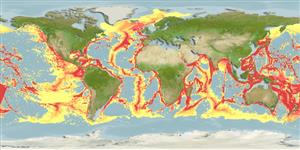
Worldwide in tropical and subtropical waters.
Comprimento de primeira maturação / Tamanho / Peso / Idade
Maturidade: Lm ? range ? - ? cm Max length : 16.0 cm TL macho/indeterminado; (Ref. 96968)
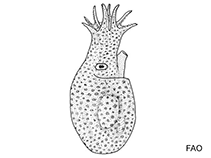
Maximum depth from Ref. 110525. Depth range from 200 to 1,000 m. These small pelagic octopuses typically occur over deeper water as adults. Young animals tend to occur in the shallower end of the range. As members of this species reach sexual maturity the iridescence of the digestive gland and eyes is lost, and animals migrate to deeper darker waters in the later stages of the life cycle. Nearly mature males have salivary glands that are much larger than those of comparable females. Salivary products may be used as chemical attractant for females. The female light organ may be used for reproductive signalling to males (Ref. 96968).
Ciclo de vida ou comportamento de acasalamento
Maturidade | Reprodução | Desova | Ovos | Fecundidade | Larvas
Members of the class Cephalopoda are gonochoric. Male and female adults usually die shortly after spawning and brooding, respectively. Mating behavior: Males perform various displays to attract potential females for copulation. During copulation, male grasp the female and inserts the hectocotylus into the female's mantle cavity where fertilization usually occurs. Life cycle: Embryos hatch into planktonic stage and live for some time before they grow larger and take up a benthic existence as adults.
Turgeon, D.D., J.F. Quinn Jr., A.E. Bogan, E.V. Coan, F.G. Hochberg, W.G. Lyons, P.M. Mikkelsen, R.J. Neves, C.F.E. Roper, G. Rosenberg, B. Roth, A. Scheltema, F.G. Thompson, M. Vecchione and J.D. Willams 1998 Common and scientific names of aquatic invertebrates from the United States and Canada: Mollusks, 2nd ed. American Fisheries Society (Special publication 26), Bethesda, Maryland. 526 p. (Ref. 1667)
Status na Lista Vermelha da UICN
(Ref. 130435: Version 2025-2 (Global))
Status no CITES (Ref. 108899)
Not Evaluated
Not Evaluated
Ameaça para os humanos
Uso pelos humanos
FAO - Publication: search | FishSource |
Ferramentas
Mais informação
Dinâmica populacionalCrescimentoIdade máxima / tamanhosRelação comprimento-peso.Relação comprimento-comprimento.Frequências de comprimentoConversão de massaAbundância Ciclo de vidaReproduçãoMaturidadeFecundidadeDesovaOvosDesenvolvimento dos ovosLarvas FisiologiaConsumo de oxigênio
Relacionado a humanosSelos, moedas, diversos.
Fontes da internet
Estimativas baseadas em modelos
Vulnerabilidade da pesca
(Ref. 71543) |
Low vulnerability (10 of 100). |
Categoria de preço
(Ref. 80766): |
Unknown. |