Cephalopoda |
Octopoda |
Bolitaenidae
Ambiente: milieu / zona climatica / distribuzione batimetrica / gamma di distribuzione
Ecologia
Pelagico; distribuzione batimetrica 200 - 4000 m (Fonte Biblio. 96968). Subtropical
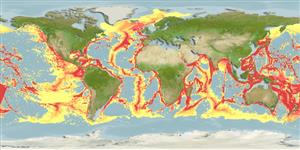
Worldwide in tropical and subtropical waters.
Lunghezza alla prima maturità / Dimensione / Peso / Età
Maturità: Lm ? range ? - ? cm Max length : 16.0 cm TL maschio/sesso non determinato; (Fonte Biblio. 96968)
Maximum depth from Ref. 110525. Depth range from 200 to 1,000 m. These small pelagic octopuses typically occur over deeper water as adults. Young animals tend to occur in the shallower end of the range. As members of this species reach sexual maturity the iridescence of the digestive gland and eyes is lost, and animals migrate to deeper darker waters in the later stages of the life cycle. Nearly mature males have salivary glands that are much larger than those of comparable females. Salivary products may be used as chemical attractant for females. The female light organ may be used for reproductive signalling to males (Ref. 96968).
Ciclo vitale e comportamento di accoppiamento
Maturità | Riproduzione | Deposizione | Uova | Fecondità | Larve
Members of the class Cephalopoda are gonochoric. Male and female adults usually die shortly after spawning and brooding, respectively. Mating behavior: Males perform various displays to attract potential females for copulation. During copulation, male grasp the female and inserts the hectocotylus into the female's mantle cavity where fertilization usually occurs. Life cycle: Embryos hatch into planktonic stage and live for some time before they grow larger and take up a benthic existence as adults.
Turgeon, D.D., J.F. Quinn Jr., A.E. Bogan, E.V. Coan, F.G. Hochberg, W.G. Lyons, P.M. Mikkelsen, R.J. Neves, C.F.E. Roper, G. Rosenberg, B. Roth, A. Scheltema, F.G. Thompson, M. Vecchione and J.D. Willams 1998 Common and scientific names of aquatic invertebrates from the United States and Canada: Mollusks, 2nd ed. American Fisheries Society (Special publication 26), Bethesda, Maryland. 526 p. (Fonte Biblio. 1667)
Stato della Lista Rossa IUCN
(Fonte Biblio. 130435: Version 2025-2 (Global))
Stato della CITES (Fonte Biblio. 108899)
Not Evaluated
CMS (Fonte Biblio. 116361)
Not Evaluated
Minaccia per l'uomo
Usi umani
FAO - Publication: search | FishSource |
Strumenti
Informazioni ulteriori
Dinamica della popolazione Ciclo di vitaRiproduzioneMaturitàFeconditàDeposizioneUovaSviluppo delle uovaLarve FisiologiaConsumo di ossigeno
Legato all'uomoFrancobolli, monete, materiale vario.
Fonti Internet
Stime basate su modelli
Vulnerabilità della pesca
(Fonte Biblio. 71543) |
Low vulnerability (10 of 100). |
Categoria di prezzo
(Fonte Biblio. 80766): |
Unknown. |