Cephalopoda |
Oegopsida |
Ommastrephidae | Illicinae
Environnement : milieu / zone climatique / profondeur / gamme de distribution
Écologie
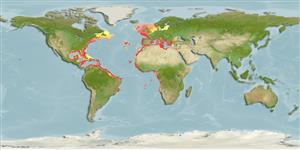
Pelagic-oceanic; profondeur 0 - 1000 m (Réf. 417), usually 100 - 600 m (Réf. 2464). Subtropical, preferred 21°C (Réf. 107945); 61°N - 20°S, 98°W - 36°E (Réf. 275)
Atlantic Ocean and the Mediterranean.
Longueur à la première maturité / Taille / Poids / Âge
Maturité: Lm 20.7 range ? - ? cm Max length : 28.0 cm ML mâle / non sexé; (Réf. 104052); 38 cm ML (female); âge max. reporté: 1.00 années (Réf. 2450)
Description synthétique
Morphologie
Eggs range from 0.08 to 0.13 cm (Ref. 2465). Egg jelly completely transparent and egg chorion swells as embryo develops reaching a diameter of about 0.2 cm during hatching. Paralarvae reach a mantle length of 0.14 cm (Ref. 2462).
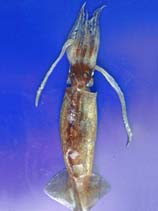
Paralarvae: No ocular or visceral photophores; suckers on proboscis tip equal in size; proboscis length characteristically 50 to 75% mantle length; proboscis division begins at 0.4 cm mantle length and is completed at 10 cm mantle length. Juveniles and adults: Arms with 2 rows of suckers. Tentacular club with 8 transverse rows of minute subequal suckers. Largest sucker rings on manus of club are notched, forming low, truncate to bluntly rounded crenulations in distal half or throughout.; not smooth. Tentacular fixing apparatus weakly developed. Left or right male ventral arm hectocotylized with modified length ranging from 15 to 33% of arm length, distal trabeculae modified to papillose flaps. Length of suckerless base of hectocotylized arm is about 13% of total length of arm. Head-width index high, 23 (19-26) in mature males and 19 (15-22) in mature females. Lower beak with long and strong jaw edge; upper beak with long and strong hood. Funnel cartilage is T-shaped and inversed. Fins are rhomboid, width range from 45 to 60% of the mantle length. Mantle width 15 to 25% of mantle length. Funnel groove without foveola or lateral pockets (Ref. 275).
Females grow larger than males (Ref. 3722). Neritic, oceanic (Ref. 91956). Inhabits muddy, sandy and detritic bottoms covered with Funiculina spp. (Ref. 2453) in middle and lower sub-littoral and upper bathyal zones in temperate latitudes. In general, juveniles and adults share the same depth range throughout the year; many large individuals can be found in deeper waters (Ref. 64257). Performs diel vertical movements (Ref. 275) as well as seasonal migrations (Ref. 64257). Opportunistic predator (Ref. 2450, 64257), feeding on the most abundant prey available, even consuming tunicates (Ref. 64257). Mainly feeds on fish, crustaceans and cephalopods (Refs. 2450, 64257). Comes very close to the seabed but was observed to mainly feed on prey swimming off the bottom (Ref. 64257). Exhibits cannibalism (Ref. 2482).
Cycle de vie et comportement reproducteur
Maturité | Reproduction | Frai | Œufs | Fécondité | Larves
Mature eggs in ovary and oviducts range between 50,000 and 200,000 (Ref. 2464). Number and length of spermatophores increase with size of animal, number varying from 81 to 1,555 and mantle length between 1.4 and 3.8 cm. Fecundity varies in animal size (Ref. 2451). Embryonic development takes about 10 to 14 days at 15°C (Ref. 2466). Juveniles are active swimmers, exhibiting gentle jet propulsion typical of planktonic cephalopod paralarvae, maintaining a head down and oblique position (Ref. 2462). Intermittent spawner lasting from a few days to a few weeks (Ref. 2467). Spawning occurs all year with seasonal peaks varying widely with areas and seasons. Sex ratio is 1:1 (Ref. 2450).
Piatkowski, U. 2006 Illex coindetii. Broadtail shortfin squid. Life history species review. CEPHSTOCK: Cephalopod Stocks in European Waters. Review, Analysis, Assessment and Sustainable Management. 20 p. (Réf. 2450)
Statut dans la liste rouge de l'IUCN
(Réf. 130435: Version 2025-2 (Global))
statut CITES (Réf. 108899)
Not Evaluated
Not Evaluated
Menace pour l'homme
Utilisations par l'homme
Pêcheries: commercial
FAO - pêcheries: landings search; Publication: search | FishSource | Sea Around Us
Outils
Plus d'informations
Dynamique des populations PhysiologieConsommation d'oxygène
Liées à l'hommeTimbres, pièces de monnaie, divers
Sources Internet
Estimations basées sur des modèles
Résilience
(Ref. 69278): |
Milieu, temps minimum de doublement de population : 1,4 à 4,4 années (K=0.2-0.21; tm=0.6; tmax=1) |
Rate of population increase
|
Prior r = 0.61, 95% CL = 0.40 - 0.91, Based on 3 full stock assessments. |
Vulnérabilité de la pêche
(Réf. 71543) |
Low to moderate vulnerability (31 of 100). |
Vulnérabilité climatique
(Réf. 125649) |
(0 of 100) |
Catégorie de prix
(Réf. 80766): |
Very high. |
Nutrients
|
Calcium = 126 [75, 177] mg/100g; Iron = 4.79 [1.67, 7.92] mg/100g; Protein = 15.5 [13.7, 17.4] %; Omega3 = 0.414 [0.262, 0.566] g/100g; Selenium = 57.8 [48.5, 67.2] μg/100g; VitaminA = 0 μg/100g; Zinc = 1.97 [0.92, 3.02] mg/100g (wet weight); based on nutrient studies. |