Cephalopoda |
Oegopsida |
Ommastrephidae | Todarodinae
Ambiente: milieu / zona climatica / distribuzione batimetrica / gamma di distribuzione
Ecologia
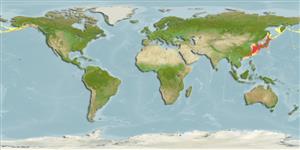
Pelagico; oceanodromo (Fonte Biblio. 75927); distribuzione batimetrica 0 - 500 m (Fonte Biblio. 275), usually 0 - 100 m (Fonte Biblio. 275). Temperate; 5°C - 27°C (Fonte Biblio. 275), preferred 9°C (Fonte Biblio. 107945); 63°N - 18°N, 106°E - 127°W
North Pacific: from northern Vietnam, north to Russia and east to Canada.
Lunghezza alla prima maturità / Dimensione / Peso / Età
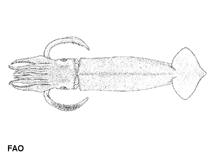
Maturità: Lm ? range ? - ? cm Max length : 50 cm ML (female); common length : 30.0 cm ML maschio/sesso non determinato; (Fonte Biblio. 97142); peso massimo pubblicato: 500.00 g (Fonte Biblio. 275)
Common weight: 100 to 300 g (Ref. 275). Depth range is 36 to 184 m; and temperature is 12 to 20°C in Ref. 75927. Fished with jigging machines, demersal trawls, purse seines and set nets (Ref. 81298). Lives in surface waters of open oceans and coastal areas (Ref. 843). Feeds on myctophids, anchovies, crustaceans, gastropod larvae, chaetognaths (Ref. 275).
Ciclo vitale e comportamento di accoppiamento
Maturità | Riproduzione | Deposizione | Uova | Fecondità | Larve
Members of the class Cephalopoda are gonochoric. Male and female adults usually die shortly after spawning and brooding, respectively. Mating behavior: Males perform various displays to attract potential females for copulation. During copulation, male grasp the female and inserts the hectocotylus into the female's mantle cavity where fertilization usually occurs. Life cycle: Embryos hatch into planktonic stage and live for some time before they grow larger and take up a benthic existence as adults.
Roper, C.F.E., M.J. Sweeney and C.E. Nauen 1984 FAO Species Catalogue. Vol. 3. Cephalopods of the world. An annotated and illustrated catalogue of species of interest to fisheries. FAO Fish. Synop. 125(3):277p. Rome: FAO. (Fonte Biblio. 275)
Stato della Lista Rossa IUCN
(Fonte Biblio. 130435: Version 2025-2 (Global))
Stato della CITES (Fonte Biblio. 108899)
Not Evaluated
CMS (Fonte Biblio. 116361)
Not Evaluated
Minaccia per l'uomo
Usi umani
Pesca: commerciale
FAO - pesca: profilo della specie, landings search; Publication: search | FishSource | Sea Around Us
Strumenti
Informazioni ulteriori
Dinamica della popolazione FisiologiaConsumo di ossigeno
Legato all'uomoFrancobolli, monete, materiale vario.
Fonti Internet
Stime basate su modelli
Resilienza
(Ref. 69278): |
Alto, tempo minimo di raddoppiamento della popolazione meno di 15 mesi (K=2.85-3.34) |
Rate of population increase
|
Prior r = 1.18, 95% CL = 0.78 - 1.77, Based on 2 full stock assessments. |
Vulnerabilità della pesca
(Fonte Biblio. 71543) |
Low vulnerability (25 of 100). |
Vulnerabilità climatica
(Fonte Biblio. 125649) |
(0 of 100) |
Categoria di prezzo
(Fonte Biblio. 80766): |
Medium. |
Nutrients
|
Calcium = 126 [75, 177] mg/100g; Iron = 4.79 [1.67, 7.92] mg/100g; Protein = 15.5 [13.7, 17.4] %; Omega3 = 0.414 [0.262, 0.566] g/100g; Selenium = 57.8 [48.5, 67.2] μg/100g; VitaminA = 0 μg/100g; Zinc = 1.97 [0.92, 3.02] mg/100g (wet weight); based on nutrient studies. |