Cephalopoda |
Octopoda |
Octopodidae | Octopodinae
Umwelt: Milieu / Klimazone / Tiefenbereich / Verbreitungsgebiet
Ökologie
Benthic; tiefenbereich 30 - 120 m (Ref. 275). Tropical; 41°N - 24°S, 32°E - 143°E (Ref. 275)
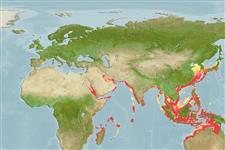
Indo-West Pacific: from Mozambique to Red Sea and Japan.
Länge bei der ersten Reifung / Größe / Gewicht / Alter
Geschlechtsreife: Lm ? range ? - ? cm Max length : 10.0 cm ML Männchen/unbestimmt; (Ref. 275); max. veröff. Gewicht: 400.00 g (Ref. 275)
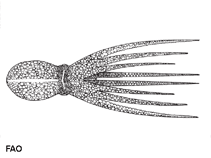
A small to moderate-sized species recognized by a distinctive color pattern consisting of large, light-colored round patches, separated by dark reticulations over the entire dorsal surface. There is also a light cream-colored longitudinal stripe along the dorsal midline of the mantle.
Maximum total length is 30 cm. Supports subsistence fisheries in East Africa (Ref. 3722). Found in sand and muddy sand areas. Inhabits holes and defends its turf. Solitary with crepuscular behavior (Ref. 101169). Benthic. Inhabits the continental shelf (Ref. 9773).
Lebenszyklus und Paarungsverhalten
Geschlechtsreife | Fortpflanzung | Ablaichen | Eier | Fruchtbarkeit | Larven
Members of the class Cephalopoda are gonochoric. Male and female adults usually die shortly after spawning and brooding, respectively. Mating behavior: Males perform various displays to attract potential females for copulation. During copulation, male grasp the female and inserts the hectocotylus into the female's mantle cavity where fertilization usually occurs. Life cycle: Embryos hatch into planktonic stage and live for some time before they grow larger and take up a benthic existence as adults.
Roper, C.F.E., M.J. Sweeney and C.E. Nauen 1984 FAO Species Catalogue. Vol. 3. Cephalopods of the world. An annotated and illustrated catalogue of species of interest to fisheries. FAO Fish. Synop. 125(3):277p. Rome: FAO. (Ref. 275)
IUCN Rote Liste Status
(Ref. 130435: Version 2025-2 (Global))
CITES Status (Ref. 108899)
Not Evaluated
Not Evaluated
Bedrohung für Menschen
Nutzung durch Menschen
Fischereien: kommerziell
FAO - Publication: search | FishSource |
Tools
Mehr Information
Trophische ÖkologieLebensmittel (Beutetiere)
Nahrungszusammensetzung
Nahrungsaufnahme
Räuber
LebenszyklusFortpflanzungGeschlechtsreifeFruchtbarkeitAblaichenEierEientwicklungLarven PhysiologieSauerstoffverbrauch
MenschenbezogenBriefmarken, Münzen, Verschiedenes.
Internet Quellen
Schätzungen auf der Grundlage von Modellen
Widerstandsfähigkeit
(Ref. 69278): |
mittel, Verdopplung der Population dauert 1,4 - 4,4 Jahre. (K=0.39) |
Anfälligkeit der Fischerei
(Ref. 71543) |
Low vulnerability (25 of 100). |
Preiskategorie
(Ref. 80766): |
Low. |