Cephalopoda |
Oegopsida |
Ommastrephidae | Ommastrephinae
Môi trường: môi trường / vùng khí hậu / Mức độ sâu / phạm vi phân phối
Sinh thái học
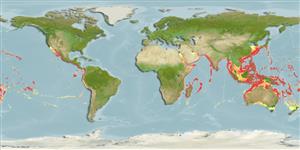
Tầng nổi; mức độ sâu 0 - 1000 m (Tài liệu tham khảo 275). Tropical; 35°N - 42°S, 19°E - 75°W (Tài liệu tham khảo 97142)
Indo-Pacific. Tropical to subtropical.
Chiều dài lúc trưởng thành đầu tiên / Bộ gần gũi / Khối lượng (Trọng lượng) / Tuổi
Chín muồi sinh dục: Lm ?, range 18 - 51.3 cm Max length : 65.0 cm ML con đực/không giới tính; (Tài liệu tham khảo 97142); Khối lượng cực đại được công bố: 8.5 kg (Tài liệu tham khảo 97142)
On the basis of size differences of mature squid, as well as dorsal photophore and gladius morphology, 5 forms of undetermined status are distinguishable: 1) Dwarf form without a dorsal photophore. 2) Dwarf form with a dorsal photophore. 3) Middle-sized, typical form with a dorsal photophore and double axes on the gladius. 4) Middle-sized not typical form with a dorsal photophore and a single axis on the gladius. 5) Giant form with a dorsal photophore and a single axis on the gladius (Ref. 97142). Widely distributed, abundant and highly productive, epipelagic to mesopelagic and upper bathypelagic species that inhabits open waters over great depths of more than 200 to 400 m, at sea surface temperatures from 16° to 32°C, but usually above 20° to 22°C. Reproductive area located in the Indian Ocean northward of 18°S to 22°S, in the North Pacific Ocean between 20°N to 25°N, and in the South Pacific Ocean from 16°S to 25°S. The more high-latitude areas of the species range is used by migrant squid as foraging zones, mainly by the females of the middle-sized form. Squid migrate to high latitudes with seasonal warming during summer in their appropriate hemisphere along the shift of surface isotherms of 20° to 22°C; then return to lower latitudes with the seasonal autumn. Truly pelagic and not associated with the bottom. An active predator with a very wide spectrum of food organisms. Planktonic paralarvae and juveniles usually live in the homogenous surface layer above and near the gradient layer (0 to 75 m and 100 m). Diurnal vertical migrations by paralarvae and juveniles are absent or very short in distance. During daytime the main bulk of juveniles occurs near the surface from 0 to 30 m, while at night they descend deeper, between 25 and 75 m, moving out of the zone of maximum numbers of conspecific predatory adult squids. Subadult and adult squids are interzonal animals. At night they inhabit surface and subsurface layers from 0 to 150 m to feed, with maximum numbers between the surface and about 25 m. In the morning they descend to depths of 200 to 1,100 m and remain there during the day. Very fast growing: by the age of 300 days specimens can reach 550 to 600 mm mantle length and 8 to 9 kg body weight. Typical monocyclic r-strategist. Cruising speed of adult squid is about 3 to 10 km per hour, but the burst speed reaches greater than 25 to 35 km per hour. Nearly non-active during the day and observed either "hanging" in the water or moving slowly at 1 to 1.5 km per hour, propelled by undulating fins. Its helminth fauna consists of 12 species of larvae of trematodes, cestodes, nematodes and acanthocephalans, among which are 2 representatives of nematodes that have significant negative impact on the commercial importance of the species. Larvae of Anisakis sp., a threat to human health, are localized in the ovaries and encysted in the coelomic membranes. Larvae of Porrocaecum sp. are encysted on the internal mantle wall and may significantly degrade the quality of the marketable components of the infested squid (Ref. 97142).
Mating occurs in surface layers at night in "head to head" position without preliminary rituals; promiscuity probably common. Duration of copulation short: 0.5 to 2 minutes. Spawning takes place at night in the epipelagic zone all year round, with the duration of the spawning season for individual females up to 1 to 3 months. An intermittent, multibatch spawner. After spawning once, females continue to feed and grow, while the next portion of oocytes matures; then spawning begins again. Each subsequent batch is quasi-equal in egg numbers. Egg masses are pelagic, and they float above the upper pycnocline layer. Are fast-swimming, highly manoeuvrable, and nektonic; reacts very quickly to any change in its surroundings. Juveniles are capable of "flying" during daytime (Ref. 97142).
Roper, C.F.E., M.J. Sweeney and C.E. Nauen 1984 FAO Species Catalogue. Vol. 3. Cephalopods of the world. An annotated and illustrated catalogue of species of interest to fisheries. FAO Fish. Synop. 125(3):277p. Rome: FAO. (Tài liệu tham khảo 275)
Tình trạng Sách đỏ IUCN
(Tài liệu tham khảo 130435: Version 2025-2 (Global))
tình trạng CITES (Tài liệu tham khảo 108899)
Not Evaluated
CMS (Tài liệu tham khảo 116361)
Not Evaluated
Mối đe dọa đối với con người
Sử dụng của con người
Các nghề cá: tính thương mại
FAO - Publication: search | FishSource |
Các công cụ
Thêm thông tin
Sinh lý họcThành phần ô-xy
Liên quan đến con ngườiTem, tiền xu, v.v.
Các nguồn internet
Ước tính dựa trên mô hình
Thích nghi nhanh
(Ref. 69278): |
Chiêù cao, thời gian nhân đôi của chủng quần tối thiểu là dưới 15 tháng (K=2.18-2.39) |
Sự dễ bị tổn thương của nghề đánh cá
(Tài liệu tham khảo 71543) |
Low to moderate vulnerability (30 of 100). |
Loại giá
(Tài liệu tham khảo 80766): |
Medium. |