Sthenoteuthis oualaniensis, Purpleback flying squid : fisheries
Advertisement

You can sponsor this page

Sthenoteuthis oualaniensis   (Lesson, 1830)

Purpleback flying squid

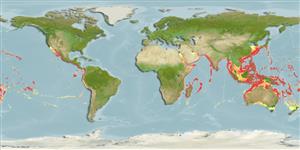
Native range | All suitable habitat | Point map | Year 2050
This map was computer-generated and has not yet been reviewed.
Sthenoteuthis oualaniensis  AquaMaps  Data sources: GBIF OBIS
上传你的 图片 
全部图片 | 谷歌图片 |
Image of Sthenoteuthis oualaniensis (Purpleback flying squid)
Sthenoteuthis oualaniensis
Picture by Khan, Muhammad Moazzam

分类 / 名称 俗名 | 同种异名 | CoL | ITIS | WoRMS

Cephalopoda | Oegopsida | Ommastrephidae | Ommastrephinae

环境:氛围 / 气候带 / 深度上下限 / 分布范围 生态学

大洋性; 深度上下限 0 - 1000 m (参考文献 275).  Tropical; 35°N - 42°S, 19°E - 75°W (参考文献 97142)

分布 Territories | FAO区域 | 生态系 | 标本纪录 | 简介

Indo-Pacific. Tropical to subtropical.

首次成熟时的长度 / 大小 / 重量 / 年龄

成熟度: Lm ?, range 18 - 51.3 cm Max length : 65.0 cm ML 雄鱼/尚未辨别雌雄; (参考文献 97142); 最大体重: 8.5 kg (参考文献 97142)

生物学特性     字汇 (例如 附生)

On the basis of size differences of mature squid, as well as dorsal photophore and gladius morphology, 5 forms of undetermined status are distinguishable: 1) Dwarf form without a dorsal photophore. 2) Dwarf form with a dorsal photophore. 3) Middle-sized, typical form with a dorsal photophore and double axes on the gladius. 4) Middle-sized not typical form with a dorsal photophore and a single axis on the gladius. 5) Giant form with a dorsal photophore and a single axis on the gladius (Ref. 97142). Widely distributed, abundant and highly productive, epipelagic to mesopelagic and upper bathypelagic species that inhabits open waters over great depths of more than 200 to 400 m, at sea surface temperatures from 16° to 32°C, but usually above 20° to 22°C. Reproductive area located in the Indian Ocean northward of 18°S to 22°S, in the North Pacific Ocean between 20°N to 25°N, and in the South Pacific Ocean from 16°S to 25°S. The more high-latitude areas of the species range is used by migrant squid as foraging zones, mainly by the females of the middle-sized form. Squid migrate to high latitudes with seasonal warming during summer in their appropriate hemisphere along the shift of surface isotherms of 20° to 22°C; then return to lower latitudes with the seasonal autumn. Truly pelagic and not associated with the bottom. An active predator with a very wide spectrum of food organisms. Planktonic paralarvae and juveniles usually live in the homogenous surface layer above and near the gradient layer (0 to 75 m and 100 m). Diurnal vertical migrations by paralarvae and juveniles are absent or very short in distance. During daytime the main bulk of juveniles occurs near the surface from 0 to 30 m, while at night they descend deeper, between 25 and 75 m, moving out of the zone of maximum numbers of conspecific predatory adult squids. Subadult and adult squids are interzonal animals. At night they inhabit surface and subsurface layers from 0 to 150 m to feed, with maximum numbers between the surface and about 25 m. In the morning they descend to depths of 200 to 1,100 m and remain there during the day. Very fast growing: by the age of 300 days specimens can reach 550 to 600 mm mantle length and 8 to 9 kg body weight. Typical monocyclic r-strategist. Cruising speed of adult squid is about 3 to 10 km per hour, but the burst speed reaches greater than 25 to 35 km per hour. Nearly non-active during the day and observed either "hanging" in the water or moving slowly at 1 to 1.5 km per hour, propelled by undulating fins. Its helminth fauna consists of 12 species of larvae of trematodes, cestodes, nematodes and acanthocephalans, among which are 2 representatives of nematodes that have significant negative impact on the commercial importance of the species. Larvae of Anisakis sp., a threat to human health, are localized in the ovaries and encysted in the coelomic membranes. Larvae of Porrocaecum sp. are encysted on the internal mantle wall and may significantly degrade the quality of the marketable components of the infested squid (Ref. 97142).

生命周期和交配行为 成熟度 | 繁殖 | 产卵场 | | 孕卵数 | 仔鱼

Mating occurs in surface layers at night in "head to head" position without preliminary rituals; promiscuity probably common. Duration of copulation short: 0.5 to 2 minutes. Spawning takes place at night in the epipelagic zone all year round, with the duration of the spawning season for individual females up to 1 to 3 months. An intermittent, multibatch spawner. After spawning once, females continue to feed and grow, while the next portion of oocytes matures; then spawning begins again. Each subsequent batch is quasi-equal in egg numbers. Egg masses are pelagic, and they float above the upper pycnocline layer. Are fast-swimming, highly manoeuvrable, and nektonic; reacts very quickly to any change in its surroundings. Juveniles are capable of "flying" during daytime (Ref. 97142).

主要参考文献 参考文献 | 合作者 | 合作者

Roper, C.F.E., M.J. Sweeney and C.E. Nauen 1984 FAO Species Catalogue. Vol. 3. Cephalopods of the world. An annotated and illustrated catalogue of species of interest to fisheries. FAO Fish. Synop. 125(3):277p. Rome: FAO. (参考文献 275)

世界自然保护联盟红皮书 (参考文献 130435: Version 2025-2 (Global))

  最不相关 (LC) ; Date assessed: 10 May 2010

引用情况 (参考文献 108899)

Not Evaluated

CMS (参考文献 116361)

Not Evaluated

对人类的威胁

人类利用

渔业: 商业性
FAO - Publication: search | FishSource |

工具

更多信息

营养生态学
生态学
人口动态
成长
最大年龄/尺寸
长度-重量关系
长短关系
体长-频率
质量转换
丰度
生命周期
繁殖
成熟度
孕卵数
产卵场

卵的发育
仔鱼
生理学
耗氧量
与人类有关
邮票、硬币、杂项
外联
分类学
参考文献

网络资源

BHL | BOLD Systems | CISTI | DiscoverLife | FAO - Publication: search | Fishipedia | GenBank (基因组, 核苷酸) | GloBI | Gomexsi | Google Books | Google Scholar | Google | PubMed | 树状分类阶层 | Wikipedia (转至, 搜寻) | 动物学的记录

基于模型的估算

回复力
(Ref. 69278):
高度, 族群倍增时间少于 15个月 (K=2.18-2.39)
渔业脆弱性
(参考文献 71543)
Low to moderate vulnerability (30 of 100).
价格分类
(参考文献 80766):
Medium.