Cephalopoda |
Octopoda |
Alloposidae
Môi trường: môi trường / vùng khí hậu / Mức độ sâu / phạm vi phân phối
Sinh thái học
Sống nổi và đáy; mức độ sâu 0 - 6787 m (Tài liệu tham khảo 96968). Subtropical
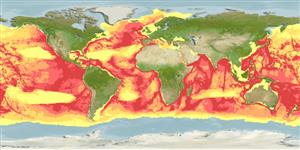
Circumglobal in tropical and subtropical waters.
Chiều dài lúc trưởng thành đầu tiên / Bộ gần gũi / Khối lượng (Trọng lượng) / Tuổi
Chín muồi sinh dục: Lm ? range ? - ? cm Max length : 10.0 cm ML con đực/không giới tính; (Tài liệu tham khảo 96968); 69 cm ML (female)
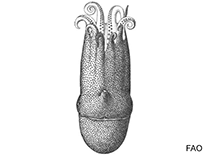
Occurs in mesopelagic and bathypelagic in open waters but often associated with continental slopes (Ref. 114825). Depth range in open-ocean from surface to at least 1,260 m, over depths of up to 6,787 m. Collected in bottom trawls on continental shelves and slopes at depths of 100 to 3,173 m. Possibly not entirely pelagic, but might pass relatively short periods of its life cycle in open waters, soon returning to a life at the bottom especially on continental slopes. Females brood their eggs attached to the oral side of the arm bases near the mouth. Likely an intermittent spawner. The deep umbrella formed by the arms and webs of the female possibly serves as the main organ of locomotion/swimming. When mature, and before autotomized, the hectocotylus of males protrudes from the pouch opening on the inner surface of web between the second and fourth pairs of arms. Feeds on crustaceans and cephalopods (Ref. 96968).
Vòng đời và hành vi giao phối
Chín muồi sinh dục | Sự tái sinh sản | Đẻ trứng | Các trứng | Sự sinh sản | Ấu trùng
Members of the class Cephalopoda are gonochoric. Male and female adults usually die shortly after spawning and brooding, respectively. Mating behavior: Males perform various displays to attract potential females for copulation. During copulation, male grasp the female and inserts the hectocotylus into the female's mantle cavity where fertilization usually occurs. Life cycle: Embryos hatch into planktonic stage and live for some time before they grow larger and take up a benthic existence as adults.
O'Shea, S. 2004 The giant octopus Haliphron atlanticus in New Zealand waters. New Zealand Journal of Zoology 31:7-13. (Tài liệu tham khảo 77104)
Tình trạng Sách đỏ IUCN
(Tài liệu tham khảo 130435: Version 2025-2 (Global))
tình trạng CITES (Tài liệu tham khảo 108899)
Not Evaluated
CMS (Tài liệu tham khảo 116361)
Not Evaluated
Mối đe dọa đối với con người
Sử dụng của con người
FAO - Publication: search | FishSource |
Các công cụ
Thêm thông tin
Vòng đờiSự tái sinh sảnChín muồi sinh dụcSự sinh sảnĐẻ trứngCác trứngSự phát triển của trứngẤu trùng Sinh lý họcThành phần ô-xy
Liên quan đến con ngườiTem, tiền xu, v.v.
Các nguồn internet
Ước tính dựa trên mô hình
Sự dễ bị tổn thương của nghề đánh cá
(Tài liệu tham khảo 71543) |
Moderate to high vulnerability (48 of 100). |
Loại giá
(Tài liệu tham khảo 80766): |
Unknown. |