Cephalopoda |
Myopsida |
Loliginidae
Môi trường: môi trường / vùng khí hậu / Mức độ sâu / phạm vi phân phối
Sinh thái học
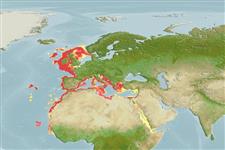
Gần đáy; mức độ sâu 68 - 431 m (Tài liệu tham khảo 114857). Subtropical, preferred 24°C (Tài liệu tham khảo 107945); 61°N - 28°S, 21°W - 47°E (Tài liệu tham khảo 275)
Eastern Atlantic, the Mediterranean and Western Indian Ocean: 20°N to 60°N, west African coast south to the Canary Islands and the Red Sea except Baltic Sea. Subtropical to polar waters.
Chiều dài lúc trưởng thành đầu tiên / Bộ gần gũi / Khối lượng (Trọng lượng) / Tuổi
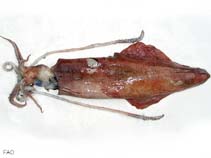
Chín muồi sinh dục: Lm ?, range 16 - ? cm Max length : 93.7 cm ML con đực/không giới tính; (Tài liệu tham khảo 275); 41 cm ML (female)
Maximum size for males is 93.7 cm, mantle length (Ref. 104052). Caught with very small boats, using jigs in daytime at depths of 80 to 100 m (Ref. 2760). Occurs in tropical and subtropical climates (Ref. 275). Found In inshore waters over rocky ground at the start of the season and on sandy or muddy bottom later in the season (Ref. 106900). Feeds on small, juvenile fishes, other cephalopods, crustaceans, polychaetes (Ref. 275).
Members of the class Cephalopoda are gonochoric. Male and female adults usually die shortly after spawning and brooding, respectively. Mating behavior: Males perform various displays to attract potential females for copulation. During copulation, male grasp the female and inserts the hectocotylus into the female's mantle cavity where fertilization usually occurs. Life cycle: Embryos hatch into planktonic stage and live for some time before they grow larger and take up a benthic existence as adults.
Roper, C.F.E., M.J. Sweeney and C.E. Nauen 1984 FAO Species Catalogue. Vol. 3. Cephalopods of the world. An annotated and illustrated catalogue of species of interest to fisheries. FAO Fish. Synop. 125(3):277p. Rome: FAO. (Tài liệu tham khảo 275)
Tình trạng Sách đỏ IUCN
(Tài liệu tham khảo 130435: Version 2025-2 (Global))
tình trạng CITES (Tài liệu tham khảo 108899)
Not Evaluated
CMS (Tài liệu tham khảo 116361)
Not Evaluated
Mối đe dọa đối với con người
Sử dụng của con người
Các nghề cá: tính thương mại
FAO - Các nghề cá: landings search; Publication: search | FishSource | Biển chung quanh ta
Các công cụ
Thêm thông tin
Sinh lý họcThành phần ô-xy
Liên quan đến con ngườiTem, tiền xu, v.v.
Các nguồn internet
Ước tính dựa trên mô hình
Sự dễ bị tổn thương của nghề đánh cá
(Tài liệu tham khảo 71543) |
Low to moderate vulnerability (34 of 100). |
Sự dễ bị tổn thương của khí hậu
(Tài liệu tham khảo 125649) |
Moderate vulnerability (38 of 100) |
Loại giá
(Tài liệu tham khảo 80766): |
Very high. |
Nutrients
|
Calcium = 126 [75, 177] mg/100g; Iron = 4.79 [1.67, 7.92] mg/100g; Protein = 15.5 [13.7, 17.4] %; Omega3 = 0.414 [0.262, 0.566] g/100g; Selenium = 57.8 [48.5, 67.2] μg/100g; VitaminA = 0 μg/100g; Zinc = 1.97 [0.92, 3.02] mg/100g (wet weight); based on nutrient studies. |