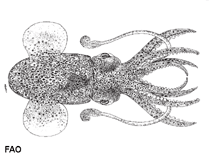
Cephalopoda |
Sepiida |
Sepiolidae | Sepiolinae
Ambiente: milieu / zona climatica / distribuzione batimetrica / gamma di distribuzione
Ecologia
Benthopelagico; distribuzione batimetrica 42 - 701 m (Fonte Biblio. 114857), usually 120 - 200 m (Fonte Biblio. 843). Temperate; 70°N - 16°N, 18°W - 37°E (Fonte Biblio. 106954)
Eastern Atlantic, the Mediterranean and Western Indian Ocean: from Norway to Mauritania and the Indian Ocean.
Lunghezza alla prima maturità / Dimensione / Peso / Età
Maturità: Lm ? range ? - ? cm Max length : 5.0 cm ML maschio/sesso non determinato; (Fonte Biblio. 3722); 4 cm ML (female)
An epipelagic-mesopelagic species, occurring within a wide depth range, from close to the surface (8 m) down to over 1000 m. Common depth range in the North Atlantic is between 50 and 300 m; and between 100-200 and 400 m in the Mediterranean. Prefers soft, muddy substrates, often on shrimp fishing grounds. Never found in brackish waters. Vertical movement of this species is linked to trophic relationships. Feeding occurs primarily from dusk to dawn, with adult animals spending the day buried in the bottom substrate. Feeds mainly on crustaceans, notably on euphausiids, and the decapod Pasiphaea sivado in the northern Tyrrhenian Sea. Undergoes seasonal movements related to reproduction. Spawning most likely continuous throughout the year, with reported peaks in reproductive activity in several different areas. Mating takes place head-to-head, generally in shallow coastal waters. Both viable and unviable eggs are deposited in various solid substrates, preferably on ascidians (Microcosmus sp.). Eggs hatch in about 2 months. Its short lifecycle is range from between 6 to 9 months. Preyed upon by several demersal fish and occasionally by cetaceans. Successfully cultured in aquaria. Abundant in the Mediterranean Sea and represents an important bycatch of many trawl fisheries. Commonly sold on Mediterranean markets, most abundant in summer, and is valued as a delicacy in certain areas such as in southern Sicily (Ref. 1695).
Ciclo vitale e comportamento di accoppiamento
Maturità | Riproduzione | Deposizione | Uova | Fecondità | Larve
Members of the class Cephalopoda are gonochoric. Male and female adults usually die shortly after spawning and brooding, respectively. Mating behavior: Males perform various displays to attract potential females for copulation. During copulation, male grasp the female and inserts the hectocotylus into the female's mantle cavity where fertilization usually occurs. Life cycle: Embryos hatch into planktonic stage and live for some time before they grow larger and take up a benthic existence as adults.
Roper, C.F.E., M.J. Sweeney and C.E. Nauen 1984 FAO Species Catalogue. Vol. 3. Cephalopods of the world. An annotated and illustrated catalogue of species of interest to fisheries. FAO Fish. Synop. 125(3):277p. Rome: FAO. (Fonte Biblio. 275)
Stato della Lista Rossa IUCN
(Fonte Biblio. 130435: Version 2025-2 (Global))
Stato della CITES (Fonte Biblio. 108899)
Not Evaluated
CMS (Fonte Biblio. 116361)
Not Evaluated
Minaccia per l'uomo
Usi umani
FAO - Publication: search | FishSource |
Strumenti
Informazioni ulteriori
Dinamica della popolazione Ciclo di vitaRiproduzioneMaturitàFeconditàDeposizioneUovaSviluppo delle uovaLarve FisiologiaConsumo di ossigeno
Legato all'uomoFrancobolli, monete, materiale vario.
Fonti Internet
Stime basate su modelli
Vulnerabilità della pesca
(Fonte Biblio. 71543) |
Low vulnerability (10 of 100). |
Categoria di prezzo
(Fonte Biblio. 80766): |
Unknown. |