Cephalopoda |
Oegopsida |
Ancistrocheiridae
สิ่งแวดล้อม : สิ่งแวดล้อม / เขตภูมิอากาศ / ระดับความลึก / ระยะการกระจายสินค้า
นิเวศวิทยา
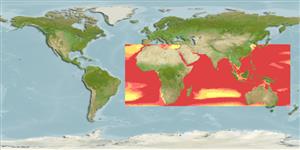
Pelagic-oceanic; ระดับความลึก 1 - 700 m (อ้างอิง 110525). Tropical; 54°N - 42°S, 180°W - 180°E (อ้างอิง 275)
Worldwide, from tropical to temperate waters.
ความยาวเมื่อครบกำหนดครั้งแรก / ขนาด / น้ำหนัก / อายุ
วัยเจริญพันธุ์: Lm ? range ? - ? cm Max length : 43.5 cm ML เพศผู้/กระเทย; (อ้างอิง 122849); น้ำหนักสูงสุดที่มีการรายงาน: 0.00 g
An oceanic species that is lower epipelagic to mesopelagic and bathyal, and ranges in tropical and temperate waters of the 3 major oceans and the Mediterranean Sea. Undergoes diel vertical migration and consequently is able to regulate its bioluminescent counterillumination. As a nerito-oceanic species, occurs in association with seamounts and submarine ridges. Age and growth studies based on statolith analysis indicate a strong sexual dimorphism: males live about 1 year, females begin to mature at 1 year and spawn at about 1.5 years. Following ontogenetic descent into bathyal waters, at least to 680 m, growth rate decreases to lowest known values for squids. Relative fecundity is 200,000 to 800,000 ova, 2.6 to 1.91 mm diameter, of which 60 to 65% are spawned. Hatching occurs throughout the year; peaks November to March. Sexually mature males captured in southern African waters had nidamental glands in addition to the fully developed male reproductive system. Intersexual males were significantly larger than normal males. Preyed upon by swordfish, Xiphias gladius, lancetfish, tunas, blue shark, oceanic seabirds, Antarctic fulmar and odontocete cetaceans, e.g. sperm whales, pygmy and dwarf sperm whales, long-finned pilot whale (Ref. 97142).
วงจรชีวิตและพฤติกรรมการผสมพันธุ์
วัยเจริญพันธุ์ | การสืบพันธุ์ | การวางไข่ | เซลสืบพันธ์ของเพศเมีย(ไข่) | ความดกของไข่ | ตัวอ่อน
Members of the class Cephalopoda are gonochoric. Male and female adults usually die shortly after spawning and brooding, respectively. Mating behavior: Males perform various displays to attract potential females for copulation. During copulation, male grasp the female and inserts the hectocotylus into the female's mantle cavity where fertilization usually occurs. Life cycle: Embryos hatch into planktonic stage and live for some time before they grow larger and take up a benthic existence as adults.
Roper, C.F.E., M.J. Sweeney and C.E. Nauen 1984 FAO Species Catalogue. Vol. 3. Cephalopods of the world. An annotated and illustrated catalogue of species of interest to fisheries. FAO Fish. Synop. 125(3):277p. Rome: FAO. (อ้างอิง 275)
สถานะบัญชีแดงของ IUCN
(อ้างอิง 130435: Version 2025-2 (Global))
สถานะไซเตส (อ้างอิง 108899)
Not Evaluated
CMS (อ้างอิง 116361)
Not Evaluated
ภัยคุกคามต่อมนุษย์
Harmless
การใช้ของมนุษย์
FAO - Publication: search | FishSource |
เครื่องมือ
ข้อมูลเพิ่มเติม
นิเวศวิทยาเขตร้อนรายการอาหาร (เหยื่อ)องค์ประอบของอาหารการบริโภคอาหารผู้ล่า วงจรชีวิตการสืบพันธุ์วัยเจริญพันธุ์ความดกของไข่การวางไข่เซลสืบพันธ์ของเพศเมีย(ไข่)การพัฒนาไข่ตัวอ่อน เกี่ยวข้องกับมนุษย์แสตมป์ เหรียญ อื่นๆ
แหล่งที่มาจากอินเตอร์เน็ต
การประมาณค่าตามแบบจำลอง
ความเสี่ยงต่อการตกปลา
(อ้างอิง 71543) |
Low to moderate vulnerability (34 of 100). |
หมวดหมู่ราคา
(อ้างอิง 80766): |
Medium. |