Cephalopoda |
Oegopsida |
Ancistrocheiridae
Ambiente: milieu / zona climatica / distribuzione batimetrica / gamma di distribuzione
Ecologia
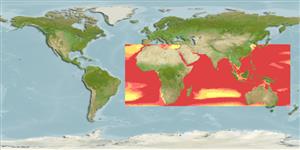
Pelagic-oceanic; distribuzione batimetrica 1 - 700 m (Fonte Biblio. 110525). Tropical; 54°N - 42°S, 180°W - 180°E (Fonte Biblio. 275)
Worldwide, from tropical to temperate waters.
Lunghezza alla prima maturità / Dimensione / Peso / Età
Maturità: Lm ? range ? - ? cm Max length : 43.5 cm ML maschio/sesso non determinato; (Fonte Biblio. 122849); peso massimo pubblicato: 0.00 g
An oceanic species that is lower epipelagic to mesopelagic and bathyal, and ranges in tropical and temperate waters of the 3 major oceans and the Mediterranean Sea. Undergoes diel vertical migration and consequently is able to regulate its bioluminescent counterillumination. As a nerito-oceanic species, occurs in association with seamounts and submarine ridges. Age and growth studies based on statolith analysis indicate a strong sexual dimorphism: males live about 1 year, females begin to mature at 1 year and spawn at about 1.5 years. Following ontogenetic descent into bathyal waters, at least to 680 m, growth rate decreases to lowest known values for squids. Relative fecundity is 200,000 to 800,000 ova, 2.6 to 1.91 mm diameter, of which 60 to 65% are spawned. Hatching occurs throughout the year; peaks November to March. Sexually mature males captured in southern African waters had nidamental glands in addition to the fully developed male reproductive system. Intersexual males were significantly larger than normal males. Preyed upon by swordfish, Xiphias gladius, lancetfish, tunas, blue shark, oceanic seabirds, Antarctic fulmar and odontocete cetaceans, e.g. sperm whales, pygmy and dwarf sperm whales, long-finned pilot whale (Ref. 97142).
Ciclo vitale e comportamento di accoppiamento
Maturità | Riproduzione | Deposizione | Uova | Fecondità | Larve
Members of the class Cephalopoda are gonochoric. Male and female adults usually die shortly after spawning and brooding, respectively. Mating behavior: Males perform various displays to attract potential females for copulation. During copulation, male grasp the female and inserts the hectocotylus into the female's mantle cavity where fertilization usually occurs. Life cycle: Embryos hatch into planktonic stage and live for some time before they grow larger and take up a benthic existence as adults.
Roper, C.F.E., M.J. Sweeney and C.E. Nauen 1984 FAO Species Catalogue. Vol. 3. Cephalopods of the world. An annotated and illustrated catalogue of species of interest to fisheries. FAO Fish. Synop. 125(3):277p. Rome: FAO. (Fonte Biblio. 275)
Stato della Lista Rossa IUCN
(Fonte Biblio. 130435: Version 2025-2 (Global))
Stato della CITES (Fonte Biblio. 108899)
Not Evaluated
CMS (Fonte Biblio. 116361)
Not Evaluated
Minaccia per l'uomo
Harmless
Usi umani
FAO - Publication: search | FishSource |
Strumenti
Informazioni ulteriori
Ecologia troficaArticoli alimentari (prede)AlimentazioneConsumo di ciboPredatori Dinamica della popolazione Ciclo di vitaRiproduzioneMaturitàFeconditàDeposizioneUovaSviluppo delle uovaLarve FisiologiaConsumo di ossigeno
Legato all'uomoFrancobolli, monete, materiale vario.
Fonti Internet
Stime basate su modelli
Vulnerabilità della pesca
(Fonte Biblio. 71543) |
Low to moderate vulnerability (34 of 100). |
Categoria di prezzo
(Fonte Biblio. 80766): |
Medium. |