Ascidiacea |
Aplousobranchia |
Holozoidae
Umwelt: Milieu / Klimazone / Tiefenbereich / Verbreitungsgebiet
Ökologie
Sessile; tiefenbereich 0 - 1000 m (Ref. 3435). Polar
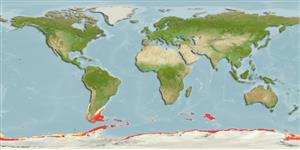
Southwest Atlantic, Southeast Pacific and the Antarctic: From Antarctica to South America.
Länge bei der ersten Reifung / Größe / Gewicht / Alter
Geschlechtsreife: Lm ? range ? - ? cm Max length : 8.0 cm COLD Männchen/unbestimmt; (Ref. 3373)
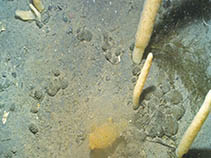
Maximum depth from Ref. 3373. Colony is up to 700 cm long and 8 cm in diameter (Ref. 3373). Found on soft bottom substrates, weakly attached to mud, and on moraine deposits at a depth of 30 m (Ref. 1753), and even on rocky bottoms and prefer areas with a little current when they reach a considerable height (Ref. 87801).
Lebenszyklus und Paarungsverhalten
Geschlechtsreife | Fortpflanzung | Ablaichen | Eier | Fruchtbarkeit | Larven
Members of the class Ascidiacea are hermaphroditic; both cross- and self-fertilization is typical. Life cycle: Eggs develop into lecithotrophic larva before metamorphosing into benthic adults.
Tatian, M., R.J. Sahade, M.E. Doucet and G.B. Esnal 1998 Ascidians (tunicata, ascidiacea) of Potter cove, South Shetland Islands, Antarctica. Antarc. Sci. 10(2):147-152. (Ref. 1753)
IUCN Rote Liste Status
(Ref. 130435: Version 2025-2 (Global))
CITES Status (Ref. 108899)
Not Evaluated
Not Evaluated
Bedrohung für Menschen
Nutzung durch Menschen
FAO - Publication: search | FishSource |
Tools
Mehr Information
Trophische ÖkologieLebensmittel (Beutetiere)
Nahrungszusammensetzung
Nahrungsaufnahme
Räuber
PopulationsdynamikWachstumMax. Alter/GrößenLänge-Gewicht-Rel.Länge-Länge-Verhältnis.LängenhäufigkeitenMassenkonvertierungDichte LebenszyklusFortpflanzungGeschlechtsreifeFruchtbarkeitAblaichenEierEientwicklungLarven PhysiologieSauerstoffverbrauch
MenschenbezogenBriefmarken, Münzen, Verschiedenes.
Internet Quellen
Schätzungen auf der Grundlage von Modellen
Anfälligkeit der Fischerei
(Ref. 71543) |
Low vulnerability (10 of 100). |
Preiskategorie
(Ref. 80766): |
Unknown. |