Holothuroidea |
Holothuriida |
Holothuriidae
البيئة: الوسط / المنطقة المناخية / نطاق العمق / نطاق التوزيع
البيئة
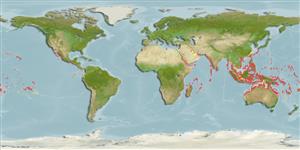
Benthic; نطاق العمق 0 - 30 m (مرجع 800). Tropical; 30°N - 32°S, 32°E - 78°W (مرجع 97480)
Indo-Pacific.
الطول عند النضج الأول / الحجم / وزن / العمر
النضج: Lm 15.5 range ? - ? cm Max length : 60.0 cm TL ذكر/ مختلط الجنس; (مرجع 118); common length : 20.0 cm TL ذكر/ مختلط الجنس; (مرجع 122); أعلا وزن تم نشرة: 1.0 kg (مرجع 122)
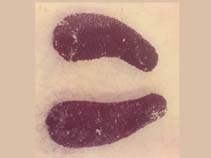
Body Width: 10 cm. Body Thickness: 0.8 cm. Mean live weight about 200 g to 1000 g; body thickness about 4 mm. Body: cylindrical, elongate, with rounded ends. Tegument smooth, often covered by sand, but also showing round patches lacking sand. A red toxic fluid is secreted upon rubbing the body surface vigorously. Podia on bivium sparsely distributed, ending in a small disc around 150 micrometer in diameter; podia on trivium numerous, short and stout, distributed on the radii and the interradii, their calcareous disc around 0.05 cm in diameter. Mouth: ventral, surrounded by 20 black tentacles. Anus terminal. Calcareous ring with large radial pieces and narrow interradials. Cuvierian tubules absent. Color: entirely black. Spicules: tegument with tables and rosettes; tables with circular disc showing 8 holes (4 central and 4 smaller holes in between) and s spire of 4 pillars, ending in maltese crown; rosettes small and simple, more abundant in ventral tegument; ventral podia without rods, but with pseudo-plates; dorsal podia and papillae with short rods, showing denticulate borders.
The mean population density is around 0.5 per square meter, but can exceed 4 per square meter. Traditionally harvested, but the processed product is of low commercial value. In recent times, due to increasing demand, this species also appears in the processed products of many Pacific Islands. Collected by hand at low tide while wading on the reefs, or by divers (Ref. 122). Processed to trepang in Puerto Princesa, Palawan (Ref. 543). A common shallow-water species, rarely found at depths of more than 20 m, mostly on inner and outer reef flats and back reefs or shallow coastal lagoons; abundant on sandy-muddy grounds with rubble or coral patches and in seagrass beds (Ref. 122). Intertidal. Also found on coarse and fine sandy areas in coral communities (Ref. 129602). Body is often almost completely covered by sand grains (Ref. 102838). The mean population density is about 0.5/square meter, but can exceed 4/square meter. Inshore shallow-water populations are denser, composed of smaller individuals, while deeper or outer reef populations, individuals are more scattered and with larger sizes (Ref. 122). Feeds on Halimeda sp. (Ref. 118). Known to release a wine-colored exudate when rubbed vigorously (Ref. 85218).
دورة الحياة وسلوك التزاوج
النضج | التكاثر | وضع البيض | بيض | الخصوبة | اليرقات
Inshore shallow-water populations composed of smaller individuals, and reproduce mostly by transversal fission, while in deeper or outer reef populations the individuals are larger, and reproduce sexually (Ref. 122).
Conand, C. 1998 Holothurians (sea cucumbers, Class Holothuroidea). p. 1157-1190. In Carpenter, K.E. and V.H. Niem (eds.) FAO Species Identification Guide for Fishery Purposes. The Living Marine Resources of the Western Central Pacific. Vol. 2. Cephalopods, crustaceans, holothurians and sharks. FAO Rome. (مرجع 122)
حالة القائمة الحمراء للاتحاد الدولي لحفظ الطبيعة والموارد الطبيعية
(مرجع 130435: Version 2025-2 (Global))
حالته حسب اتفاقية سايتس (مرجع 108899)
Not Evaluated
Not Evaluated
خطر للأنسان
استخدامات بشرية
مصائد: غير مهمة تجارياً
FAO - Publication: search | FishSource | البحر حولنا
أدوات
مزيد من المعلومات
علم وظائف الأعضاءاستهلاك الأوكسجين
ذات الصلة بالبشرطوابع بريدية وعملات معدنية ومتنوعة
مصادر علي الأنترنت
تقديرات تستند إلى النماذج
المرونه
(Ref. 69278): |
عالي, الحد الزمني الأدني لتضاعف عدد أفراد المجتمع أقل من 15 شهر (K=0.11-0.75) |
ضعف الصيد
(مرجع 71543) |
Low to moderate vulnerability (32 of 100). |
فئة السعر
(مرجع 80766): |
Unknown. |
Nutrients
|
Calcium = 126 [75, 177] mg/100g; Iron = 4.79 [1.67, 7.92] mg/100g; Protein = 16.6 [15.4, 17.8] %; Omega3 = 0.331 [0.263, 0.400] g/100g; Selenium = 57.8 [48.5, 67.2] μg/100g; VitaminA = 0 μg/100g; Zinc = 1.97 [0.92, 3.02] mg/100g (wet weight); based on nutrient studies. |