Holothuroidea |
Synallactida |
Stichopodidae
Environnement : milieu / zone climatique / profondeur / gamme de distribution
Écologie
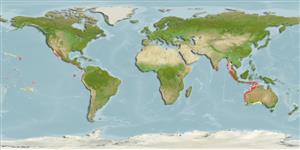
Benthic; profondeur 0 - 61 m (Réf. 83942). Tropical; 33°N - 17°S, 119°W - 73°W
Eastern Pacific: From Baja California, Mexico to Peru.
Longueur à la première maturité / Taille / Poids / Âge
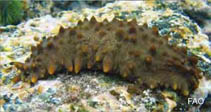
Maturité: Lm ? range ? - ? cm Max length : 31.0 cm TL mâle / non sexé; (Réf. 97450)
Deposit-feeders (Ref. 481).
Cycle de vie et comportement reproducteur
Maturité | Reproduction | Frai | Œufs | Fécondité | Larves
Members of the class Holothuroidea are gonochoric and have only one gonad. Spawning and fertilization are both external and some exhibit brooding. Life cycle: Embryos develop into planktotrophic larvae (auricularia) then into doliolaria (barrel-shaped stage) which later metamorphose into juvenile sea cucumbers (Ref. 833).
CITES 2009 Appendices I, II and III valid from 22 May 2009. UNEP. (Réf. 82577)
Statut dans la liste rouge de l'IUCN
(Réf. 130435: Version 2025-2 (Global))
statut CITES (Réf. 108899)
Not Evaluated
Menace pour l'homme
Utilisations par l'homme
Pêcheries: commercial
FAO - Publication: search | FishSource |
Outils
Plus d'informations
Écologie trophiqueAliments (proies)
Composition du régime alimentaire
Consommation alimentaire
Prédateurs
Dynamique des populations PhysiologieConsommation d'oxygène
Liées à l'hommeTimbres, pièces de monnaie, divers
Sources Internet
Estimations basées sur des modèles
Résilience
(Ref. 69278): |
Milieu, temps minimum de doublement de population : 1,4 à 4,4 années (K=0.18-0.27) |
Vulnérabilité de la pêche
(Réf. 71543) |
Moderate vulnerability (37 of 100). |
Catégorie de prix
(Réf. 80766): |
Unknown. |