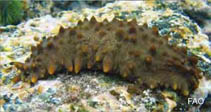
Holothuroidea |
Synallactida |
Stichopodidae
Environment: milieu / climate zone / depth range / distribution range
Ecology
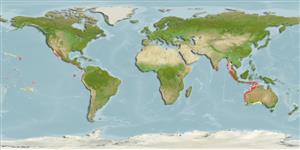
Benthic; depth range 0 - 61 m (Ref. 83942). Tropical; 33°N - 17°S, 119°W - 73°W
Eastern Pacific: From Baja California, Mexico to Peru.
Length at first maturity / Size / Weight / Age
Maturity: Lm ? range ? - ? cm Max length : 31.0 cm TL male/unsexed; (Ref. 97450)
Deposit-feeders (Ref. 481).
Life cycle and mating behavior
Maturity | Reproduction | Spawning | Eggs | Fecundity | Larvae
Members of the class Holothuroidea are gonochoric and have only one gonad. Spawning and fertilization are both external and some exhibit brooding. Life cycle: Embryos develop into planktotrophic larvae (auricularia) then into doliolaria (barrel-shaped stage) which later metamorphose into juvenile sea cucumbers (Ref. 833).
CITES 2009 Appendices I, II and III valid from 22 May 2009. UNEP. (Ref. 82577)
IUCN Red List Status
(Ref. 130435: Version 2025-2 (Global))
CITES status (Ref. 108899)
Not Evaluated
Threat to humans
Human uses
Fisheries: commercial
FAO - Publication: search | FishSource |
Tools
More information
Trophic EcologyFood items (preys)
Diet composition
Food consumption
Predators
PhysiologyOxygen consumption
Human RelatedStamps, coins, misc.
Internet sources
Estimates based on models
Resilience
(Ref. 69278): |
Medium, minimum population doubling time 1.4 - 4.4 years (K=0.18-0.27) |
Fishing Vulnerability
(Ref. 71543) |
Moderate vulnerability (37 of 100). |
Price category
(Ref. 80766): |
Unknown. |