-

- About this page
- Languages
-
Feedback
- Citation
- Upload
-
Related species
- Species in
Saccostrea - Species in
Ostreidae - - Classification -
- Ostreidae
- Ostreida
- Bivalvia
- Chordata
- Animalia
- Species in
-



Saccostrea cuccullata (Born, 1778)
Hooded oyster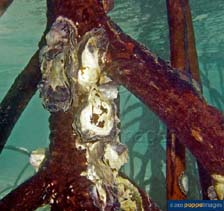
Classification / Names Common names | Synonyms | CoL | ITIS | WoRMS
Bivalvia | Ostreida | Ostreidae
Environment: milieu / climate zone / depth range / distribution range Ecology
Benthic; depth range 0 - 5 m (Ref. 348). Tropical; 45°N - 42°S, 8°E - 133°W
Distribution Countries | FAO areas | Ecosystems | Occurrences | Introductions
Indo-Pacific and Eastern Atlantic. Introduced in the Mediterranean.
Length at first maturity / Size / Weight / Age
Maturity: Lm ? range ? - ? cm Max length : 20.0 cm SHL male/unsexed; (Ref. 348); common length : 10.0 cm SHL male/unsexed; (Ref. 348)
Artisanal to industrial exploitation, from natural beds and by aquaculture (Ref. 348). Attached to rocks in the intertidal where it may form a distinct zone in the upper eulittoral (Ref. 801). Found in shallow subtidal levels and occurs in dense colonies (Ref. 101156). Also on the breathing roots and trunks of mangrove trees and on pier piles (Ref. 102838). Coexists with an assemblage of grazing gastropods (Ref. 101156).
Life cycle and mating behavior Maturity | Reproduction | Spawning | Eggs | Fecundity | Larvae
Members of the class Bivalvia are mostly gonochoric, some are protandric hermaphrodites. Life cycle: Embryos develop into free-swimming trocophore larvae, succeeded by the bivalve veliger, resembling a miniature clam.
Main reference
References | Coordinator | Collaborators
Poutiers, J.M. 1998 Bivalves. Acephala, Lamellibranchia, Pelecypoda. p. 123-362. In Carpenter, K. E. and V. H. Niem. 1998. FAO species identification guide for fishery purposes. The living marine resources of the Western Central Pacific. Volume 1. Seaweeds, corals, bivalves, and gastropods. Rome, FAO. (Ref. 348)
IUCN Red List Status
(Ref. 130435: Version 2025-1)
CITES status (Ref. 108899)
Not Evaluated
CMS (Ref. 116361)
Not Evaluated
Threat to humans
Human uses
Fisheries: commercial
FAO - Aquaculture: production; | FishSource | Sea Around Us
Tools
More information
Trophic Ecology
Ecology
Population dynamics
Growth
Max. ages / sizes
Length-weight rel.
Length-length rel.
Length-frequencies
Mass conversion
Abundance
Max. ages / sizes
Length-weight rel.
Length-length rel.
Length-frequencies
Mass conversion
Abundance
Life cycle
Distribution
Physiology
Oxygen consumption
Human Related
Stamps, coins, misc.
Outreach
Taxonomy
References
Internet sources
BHL | BOLD Systems | CISTI | DiscoverLife | FAO(; publication : search) | Fishipedia | GenBank (genome, nucleotide) | GloBI | Gomexsi | Google Books | Google Scholar | Google | PubMed | Tree of Life | Wikipedia (Go, Search) | Zoological Record
Estimates based on models
Preferred temperature
(Ref. 115969): 23.3 - 29.3, mean 28.2 (based on 3952 cells).
Price category
(Ref. 80766):
Unknown.
Nutrients : Calcium = 149 [71, 228] mg/100g; Iron = 8.53 [1.95, 15.11] mg/100g; Protein = 9.88 [8.64, 11.12] %; Omega3 = 0.313 [0.202, 0.423] g/100g; Selenium = 61 [50, 72] μg/100g; VitaminA = 0 μg/100g; Zinc = 2.04 [0.56, 3.51] mg/100g (wet weight); based on nutrient studies.