Bivalvia |
Cardiida |
Cardiidae
สิ่งแวดล้อม : สิ่งแวดล้อม / เขตภูมิอากาศ / ระดับความลึก / ระยะการกระจายสินค้า
นิเวศวิทยา
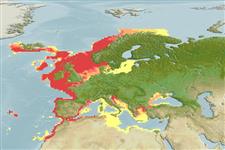
Benthic; ระดับความลึก 0 - 619 m (อ้างอิง 105829). Subtropical; 83°N - 27°N, 127°W - 36°E
Arctic, Eastern Atlantic and the Mediterranean Sea: from Canadian Arctic to Iceland, Norway, Sweden, south to Morocco, Madeira Island and Canary Islands, and the Mediterranean. Polar to subtropical.
ความยาวเมื่อครบกำหนดครั้งแรก / ขนาด / น้ำหนัก / อายุ
วัยเจริญพันธุ์: Lm ? range ? - ? cm Max length : 7.5 cm SHL เพศผู้/กระเทย; (อ้างอิง 128384)
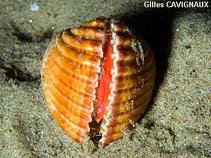
Exists at the front (Ref. 122115). Inhabits fine sand (Ref. 106083). Common in sandy-muddy deposits (Ref. 105826). Found in an estuary (Ref. 105814) and associated with coralligenous formations (Ref. 122117). Abundant in detritic bottoms (Ref. 122133). This is a sessile-burrower suspension feeder (Ref. 96498). Feeds on phytoplankton and suspended organic material (Ref. 106986).
วงจรชีวิตและพฤติกรรมการผสมพันธุ์
วัยเจริญพันธุ์ | การสืบพันธุ์ | การวางไข่ | เซลสืบพันธ์ของเพศเมีย(ไข่) | ความดกของไข่ | ตัวอ่อน
Members of the class Bivalvia are mostly gonochoric, some are protandric hermaphrodites. Life cycle: Embryos develop into free-swimming trocophore larvae, succeeded by the bivalve veliger, resembling a miniature clam.
FAO 2007 Seafood in Europe. FAO Seafood in Europe CD's 4. (อ้างอิง 78075)
สถานะบัญชีแดงของ IUCN
(อ้างอิง 130435: Version 2025-2 (Global))
สถานะไซเตส (อ้างอิง 108899)
Not Evaluated
CMS (อ้างอิง 116361)
Not Evaluated
ภัยคุกคามต่อมนุษย์
การใช้ของมนุษย์
การประมง: การค้า
FAO - Publication: search | FishSource |
เครื่องมือ
ข้อมูลเพิ่มเติม
วงจรชีวิตการสืบพันธุ์วัยเจริญพันธุ์ความดกของไข่การวางไข่เซลสืบพันธ์ของเพศเมีย(ไข่)การพัฒนาไข่ตัวอ่อน เกี่ยวข้องกับมนุษย์แสตมป์ เหรียญ อื่นๆ
แหล่งที่มาจากอินเตอร์เน็ต
การประมาณค่าตามแบบจำลอง
ความเสี่ยงต่อการตกปลา
(อ้างอิง 71543) |
Low vulnerability (10 of 100). |
หมวดหมู่ราคา
(อ้างอิง 80766): |
Low. |