Bivalvia |
Cardiida |
Cardiidae
Milieu: milieu / Klimaatzone / Diepte / verspreidingsgebied
Ecologie
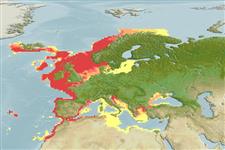
Benthic; diepte 0 - 619 m (Ref. 105829). Subtropical; 83°N - 27°N, 127°W - 36°E
Arctic, Eastern Atlantic and the Mediterranean Sea: from Canadian Arctic to Iceland, Norway, Sweden, south to Morocco, Madeira Island and Canary Islands, and the Mediterranean. Polar to subtropical.
Lengte bij maturiteit / Grootte / Gewicht / Leeftijd
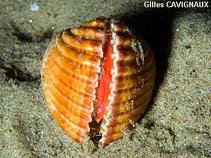
Maturiteit: Lm ? range ? - ? cm Max length : 7.5 cm SHL mannelijk / geslacht onbekend; (Ref. 128384)
Exists at the front (Ref. 122115). Inhabits fine sand (Ref. 106083). Common in sandy-muddy deposits (Ref. 105826). Found in an estuary (Ref. 105814) and associated with coralligenous formations (Ref. 122117). Abundant in detritic bottoms (Ref. 122133). This is a sessile-burrower suspension feeder (Ref. 96498). Feeds on phytoplankton and suspended organic material (Ref. 106986).
Levenscyclus en paargedrag
Maturiteit | Voortplanting | Paaien | Eieren | Fecunditeit | Larven
Members of the class Bivalvia are mostly gonochoric, some are protandric hermaphrodites. Life cycle: Embryos develop into free-swimming trocophore larvae, succeeded by the bivalve veliger, resembling a miniature clam.
FAO 2007 Seafood in Europe. FAO Seafood in Europe CD's 4. (Ref. 78075)
Status op de Rode Lijst van het IUCN
(Ref. 130435: Version 2025-2 (Global))
CITES status (Ref. 108899)
Not Evaluated
Not Evaluated
Gevaar voor de mens
Gebruik door de mens
Visserij: commercieel
FAO - Publication: search | FishSource |
Tools
Meer informatie
LevenscyclusVoortplantingMaturiteitFecunditeitPaaienEierenOntwikkeling van de eierenLarven FysiologieZuurstofverbruik
Menselijk gerelateerdPostzegels, munten, diversen.
Internetbronnen
Schattingen op basis van modellen
Kwetsbaarheid van de visserij
(Ref. 71543) |
Low vulnerability (10 of 100). |
Prijsklasse
(Ref. 80766): |
Low. |