Bivalvia |
Pectinida |
Pectinidae
Environnement : milieu / zone climatique / profondeur / gamme de distribution
Écologie
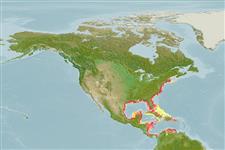
Benthic; profondeur 0 - 20 m (Réf. 83435), usually ? - 10 m (Réf. 113981). Tropical; 24°C - 26°C (Réf. 113981), preferred 20°C (Réf. 107945); 45°N - 8°N, 98°W - 66°W
Western Atlantic: Argopecten irradians irradians, Argopecten irradians concentricus, Argopecten irradians amplicostatus. Introduced in Canada and China.
Longueur à la première maturité / Taille / Poids / Âge
Maturité: Lm ? range ? - ? cm Max length : 7.5 cm SHL mâle / non sexé; (Réf. 344); âge max. reporté: 3.00 années (Réf. 126617)
Description synthétique
Morphologie
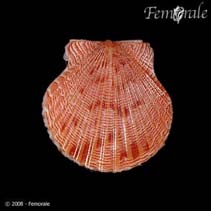
Shell valves convex, upper valve less convex than more inflated lower valve. Surface sculpture of 19 to 21 strong, squarish ribs. Hinge with wing-like projections of about same size. Colour: lower valve light, usually whitish, upper valve dark brown to dark grey with darker markings.
Average life span of 20 to 26 months. Form beds on sandy, eelgrass or other seagrass bottoms (Ref. 344).
Spawns after 1 year of age, during mass-spawning events that take place almost always in July (Ref. 344).
Leal, J.H. 2003 Bivalves. p. 25-98. In Carpenter, K.E. (ed.). The living marine resources of the Western Central Atlantic. Volume 1: Introduction, molluscs, crustaceans, hagfishes, sharks, batoid fishes, and chimaeras. FAO Species Identification Guide for Fishery Purposes and American Society of Ichthyologists and Herpetologists Special Publication No. 5. 1600p. (Réf. 344)
Statut dans la liste rouge de l'IUCN
(Réf. 130435: Version 2025-2 (Global))
statut CITES (Réf. 108899)
Not Evaluated
Not Evaluated
Menace pour l'homme
Utilisations par l'homme
Pêcheries: commercial; Aquaculture: commercial
FAO - pêcheries: landings search; Publication: search | FishSource | Sea Around Us
Outils
Plus d'informations
Dynamique des populations PhysiologieConsommation d'oxygène
Liées à l'hommeTimbres, pièces de monnaie, divers
Sources Internet
Estimations basées sur des modèles
Vulnérabilité de la pêche
(Réf. 71543) |
Low vulnerability (15 of 100). |
Vulnérabilité climatique
(Réf. 125649) |
Very high vulnerability (77 of 100) |
Catégorie de prix
(Réf. 80766): |
Low. |
Nutrients
|
Calcium = 149 [71, 228] mg/100g; Iron = 8.53 [1.95, 15.11] mg/100g; Protein = 9.88 [8.64, 11.12] %; Omega3 = 0.313 [0.202, 0.423] g/100g; Selenium = 61 [50, 72] μg/100g; VitaminA = 0 μg/100g; Zinc = 2.04 [0.56, 3.51] mg/100g (wet weight); based on nutrient studies. |