Bivalvia |
Pectinida |
Pectinidae
Environnement : milieu / zone climatique / profondeur / gamme de distribution
Écologie
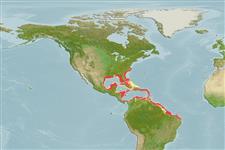
Benthic; profondeur 0 - 366 m (Réf. 83435), usually 8 - 11 m (Réf. 83435). Tropical, preferred 24°C (Réf. 107945); 38°N - 6°S, 98°W - 35°W (Réf. 83435)
Western Atlantic.
Longueur à la première maturité / Taille / Poids / Âge
Maturité: Lm ? range ? - ? cm Max length : 6.3 cm SHL mâle / non sexé; (Réf. 344); âge max. reporté: 2.00 années (Réf. 8702)
Description synthétique
Morphologie
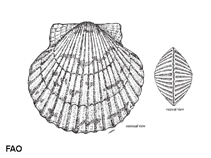
Shell outline almost circular, valves very inflated, wing-like projections relatively poorly developed. Surface sculpture of about 20 ribs, smooth square in cross-section. Hinge straight. Colour: upper valve bright, variable, ranging from brown to red to lavender rose to whitish with purplish or reddish mottlings, colour of lower valve much lighter, whitish with lighter markings.
Life span: 18 to 24 months (Ref. 350). Lives in beds in shallow to moderately deep water, usually on (or buried in) sandy bottoms (Ref. 344). Also in seagrass and algae beds (Ref. 106861).
Cycle de vie et comportement reproducteur
Maturité | Reproduction | Frai | Œufs | Fécondité | Larves
Spawning and recruitment occur throughout the year, with peaks in late autumn and spring.
Leal, J.H. 2003 Bivalves. p. 25-98. In Carpenter, K.E. (ed.). The living marine resources of the Western Central Atlantic. Volume 1: Introduction, molluscs, crustaceans, hagfishes, sharks, batoid fishes, and chimaeras. FAO Species Identification Guide for Fishery Purposes and American Society of Ichthyologists and Herpetologists Special Publication No. 5. 1600p. (Réf. 344)
Statut dans la liste rouge de l'IUCN
(Réf. 130435: Version 2025-2 (Global))
statut CITES (Réf. 108899)
Not Evaluated
Not Evaluated
Menace pour l'homme
Utilisations par l'homme
Pêcheries: hautement commercial
FAO - pêcheries: landings search; Publication: search | FishSource | Sea Around Us
Outils
Plus d'informations
Dynamique des populations Cycle de vieReproductionMaturitéFéconditéFraiŒufsDéveloppement de l'œufLarves PhysiologieConsommation d'oxygène
Liées à l'hommeTimbres, pièces de monnaie, divers
Sources Internet
Estimations basées sur des modèles
Résilience
(Ref. 69278): |
Haut, temps minimum de doublement de population inférieur à 15 mois (K=1.88-3.06; tmax=2) |
Rate of population increase
|
Prior r = 1.01, 95% CL = 0.66 - 1.51, Based on 1 data-limited stock assessment. |
Vulnérabilité de la pêche
(Réf. 71543) |
Low vulnerability (10 of 100). |
Vulnérabilité climatique
(Réf. 125649) |
High vulnerability (63 of 100) |
Catégorie de prix
(Réf. 80766): |
Medium. |
Nutrients
|
Calcium = 149 [71, 228] mg/100g; Iron = 8.53 [1.95, 15.11] mg/100g; Protein = 9.88 [8.64, 11.12] %; Omega3 = 0.313 [0.202, 0.423] g/100g; Selenium = 61 [50, 72] μg/100g; VitaminA = 0 μg/100g; Zinc = 2.04 [0.56, 3.51] mg/100g (wet weight); based on nutrient studies. |