Gastropoda |
Ostreida |
Margaritidae
Milieu: milieu / Klimaatzone / Diepte / verspreidingsgebied
Ecologie
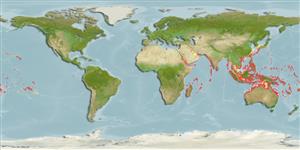
Benthic; diepte 0 - 40 m (Ref. 80041), usually 0 - 20 m (Ref. 75831). Tropical; 42°N - 26°S, 32°E - 109°W
Indo-Pacific: from Sudan south to Madagascar, north to Honshu, Japan and east to Baja California, Mexico. Introduced in the Atlantic and Mediterranean.
Lengte bij maturiteit / Grootte / Gewicht / Leeftijd
Maturiteit: Lm ? range ? - 4 cm Max length : 9.8 cm SHL mannelijk / geslacht onbekend; (Ref. 2922); max. gerapporteerde leeftijd: 15 Jaren (Ref. 129284)
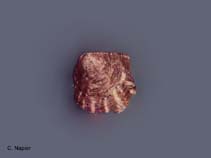
Shell rather thick and large (attaining 25 cm in length), subcircular in outline, with a short and ill-defined posterior ear which is not drawn out into a wing-like process. Anterior margin markedly protruding beyond the tip of anterior ear. Outer surface of valves, when not worn, with densely set, flattened, imbricating concentric scales and moderately long, parallel-sided and flattened spines with tapering or rounded ends; spines lying relatively flat on surface of valves, arranged in radial rows and often strongly projecting on shell margins. hinge completely devoid of teeth. Colour: outside of shell greyish brown or green to nearly black in ground colour, with radial stripes of white or yellowish markings corresponding to the basal portion of old flattened spines. Internal nacreous area silvery, with a darker smoky hue and a hint of red and green iridescence on border. Non-nacreous area very dark.
Found in shallow waters in between corals (Ref. 122680). Byssally attached to rocks and coral debris (Ref. 8010). Inhabits reef areas of lagoons (Ref. 97298). Some found lying freely on sand, coarse gravel or dead coral substrates and often found in eel grass beds and other marine plants (Ref. 80041). Also occur in mangrove areas (Ref. 129120). Feeds on phytoplankton (Ref. 96904).
A continuous spawner (peak: December to April, warm season).
Poutiers, J.M. 1998 Bivalves. Acephala, Lamellibranchia, Pelecypoda. p. 123-362. In Carpenter, K. E. and V. H. Niem. 1998. FAO species identification guide for fishery purposes. The living marine resources of the Western Central Pacific. Volume 1. Seaweeds, corals, bivalves, and gastropods. Rome, FAO. (Ref. 348)
Status op de Rode Lijst van het IUCN
(Ref. 130435: Version 2025-2 (Global))
CITES status (Ref. 108899)
Not Evaluated
Not Evaluated
Gevaar voor de mens
Gebruik door de mens
Visserij: commercieel
FAO - Publication: search | FishSource | Sea Around Us
Tools
Meer informatie
FysiologieZuurstofverbruik
Menselijk gerelateerdPostzegels, munten, diversen.
Internetbronnen
Schattingen op basis van modellen
Weerstandsvermogen
(Ref. 69278): |
Hoog, minimale populatieverdubbelingstijd minder dan 15 maanden (K=0.26-0.58) |
Kwetsbaarheid van de visserij
(Ref. 71543) |
Moderate to high vulnerability (47 of 100). |
Prijsklasse
(Ref. 80766): |
Unknown. |
Nutrients
|
Calcium = 149 [71, 228] mg/100g; Iron = 8.53 [1.95, 15.11] mg/100g; Protein = 9.88 [8.64, 11.12] %; Omega3 = 0.313 [0.202, 0.423] g/100g; Selenium = 61 [50, 72] μg/100g; VitaminA = 0 μg/100g; Zinc = 2.04 [0.56, 3.51] mg/100g (wet weight); based on nutrient studies. |