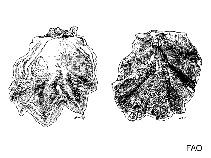
Bivalvia |
Ostreida |
Ostreidae
Milieu: milieu / Klimaatzone / Diepte / verspreidingsgebied
Ecologie
Benthic; brak water; diepte 0 - 50 m (Ref. 95344). Tropical; 26°N - 7°N, 110°W - 78°W
Eastern Central Pacific: Sinaloa, Mexico to Panama.
Lengte bij maturiteit / Grootte / Gewicht / Leeftijd
Maturiteit: Lm ? range ? - ? cm Max length : 9.0 cm SHD mannelijk / geslacht onbekend; (Ref. 95344)
Maximum shell length is 6.5 cm (Ref. 104102). Found in the intertidal zone, on mud-gravel flats, in tidepools and with freshwater seepage (Ref. 95344). Filter-feeder; feeds on phytoplankton, dissolved organic matter and detritus (Ref. 104102).
Levenscyclus en paargedrag
Maturiteit | Voortplanting | Paaien | Eieren | Fecunditeit | Larven
Members of the class Bivalvia are mostly gonochoric, some are protandric hermaphrodites. Life cycle: Embryos develop into free-swimming trocophore larvae, succeeded by the bivalve veliger, resembling a miniature clam.
The British Flora and Fauna Database 2007 The British Flora and Fauna Database. http://www.british-towns.net/nature_menu.asp (Ref. 8593)
Status op de Rode Lijst van het IUCN
(Ref. 130435: Version 2025-2 (Global))
CITES status (Ref. 108899)
Not Evaluated
Not Evaluated
Gevaar voor de mens
Gebruik door de mens
Visserij: commercieel
FAO - Publication: search | FishSource | Sea Around Us
Tools
Meer informatie
PopulatiedynamicaGroei
Max. leeftijden / maten
Lengte-gewicht rel.
Lengte-lengte rel.
Lengtefrequenties
Massaconversie
Abundantie
LevenscyclusVoortplantingMaturiteitFecunditeitPaaienEierenOntwikkeling van de eierenLarven FysiologieZuurstofverbruik
Menselijk gerelateerdPostzegels, munten, diversen.
Internetbronnen
Schattingen op basis van modellen
Kwetsbaarheid van de visserij
(Ref. 71543) |
Low vulnerability (10 of 100). |
Prijsklasse
(Ref. 80766): |
Very high. |