Hexacorallia |
Scleractinia |
Merulinidae
Milieu: milieu / Klimaatzone / Diepte / verspreidingsgebied
Ecologie
Rifbewoner; diepte 3 - 25 m (Ref. 8294). Tropical; 36°N - 34°S, 26°E - 108°E (Ref. 848)
Indo-West Pacific.
Lengte bij maturiteit / Grootte / Gewicht / Leeftijd
Maturiteit: Lm ? range ? - ? cm
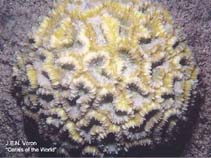
Colony: often flat and subplocoid. Corallites: clearly subplocoid on convex surfaces; crowded on flat surfaces, becoming cerioid and irregularly shaped; up to 3 centers possible. Septa: exsert, thin, irregular; steeply plunge inside the wall. Paliform lobes either poorly developed or absent. Wide variety of colors, often with contrasting corallite walls and oral discs (Ref. 848).
Depth based from occurrence (Ref. 8294); to be replaced with a better reference. Found in upper reef slopes (Ref. 848).
Levenscyclus en paargedrag
Maturiteit | Voortplanting | Paaien | Eieren | Fecunditeit | Larven
Hermaphroditic (Ref. 113712). Mature gametes are shed into the coelenteron and spawned through the mouth. Life cycle: The zygote develops into a planktonic planula larva. Metamorphosis begins with early morphogenesis of tentacles, septa and pharynx before larval settlement on the aboral end (Ref. 833).
Ross, M.A. and G. Hodgson 1981 A quantitative study of hermatypic coral diversity and zonation at Apo Reef, Mindiro, Philippines. Proceedings of the Fourth International Coral Reef Syposium, Manila 2:281-291. (Ref. 8294)
Status op de Rode Lijst van het IUCN
(Ref. 130435: Version 2025-2 (Global))
CITES status (Ref. 108899)
Not Evaluated
Gevaar voor de mens
Gebruik door de mens
FAO - Publication: search | FishSource |
Tools
Meer informatie
Trofische ecologieVoedsel (prooien)
Dieetsamenstelling
Voedselconsumptie
Predatoren
PopulatiedynamicaGroeiMax. leeftijden / matenLengte-gewicht rel.Lengte-lengte rel.LengtefrequentiesMassaconversieAbundantie FysiologieZuurstofverbruik
Menselijk gerelateerdPostzegels, munten, diversen.
Internetbronnen
Schattingen op basis van modellen
Kwetsbaarheid van de visserij
(Ref. 71543) |
(0 of 100). |
Prijsklasse
(Ref. 80766): |
Unknown. |