This website uses cookies to enhance your browsing experience and ensure the functionality of our site. For more detailed information about the types of cookies we use and how we protect your privacy, please visit our Privacy Information page..
×
Cookie Settings
This website uses different types of cookies to enhance your experience. Please select your preferences below:
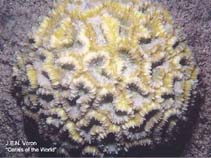
Colony: often flat and subplocoid. Corallites: clearly subplocoid on convex surfaces; crowded on flat surfaces, becoming cerioid and irregularly shaped; up to 3 centers possible. Septa: exsert, thin, irregular; steeply plunge inside the wall. Paliform lobes either poorly developed or absent. Wide variety of colors, often with contrasting corallite walls and oral discs (Ref. 848).
Depth based from occurrence (Ref. 8294); to be replaced with a better reference. Found in upper reef slopes (Ref. 848).
Hermaphroditic (Ref. 113712). Mature gametes are shed into the coelenteron and spawned through the mouth. Life cycle: The zygote develops into a planktonic planula larva. Metamorphosis begins with early morphogenesis of tentacles, septa and pharynx before larval settlement on the aboral end (Ref. 833).
Ross, M.A. and G. Hodgson 1981 A quantitative study of hermatypic coral diversity and zonation at Apo Reef, Mindiro, Philippines. Proceedings of the Fourth International Coral Reef Syposium, Manila 2:281-291. (參考文獻 8294)