Hexacorallia |
Scleractinia |
Fungiidae
Meio ambiente: milieu / Zona climática / intervalo de profundidade / faixa de distribuição
Ecologia
Associadas(os) a recifes; intervalo de profundidade 0 - 40 m (Ref. 847). Tropical; 29°N - 27°S, 34°E - 172°W (Ref. 847)
Widely distributed throughout central Indo-Pacific.
Comprimento de primeira maturação / Tamanho / Peso / Idade
Maturidade: Lm ? range ? - ? cm Max length : 60.0 cm WD macho/indeterminado; (Ref. 269)
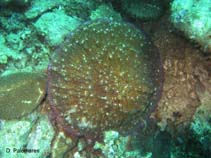
In situ, this species resembles an upside-down salad bowl, up to 60 cm in diameter and 1 to 1.5 cm thick. The septa generally run uninterrupted the entire distance from the primary corallite to the margin. Primary septa are much more exsert than secondaries, and both are strongly dentate. Corallites are irregularly distributed, but may form lines parallel to the margin. Each corallites is marked by a small mound of highly exsert septa, therefore the colony surface is rough. The underside is comparatively smooth with regulary exsert costae and low spines (Ref. 269). Zooxanthellae; free-living (Ref. 19).
In situ, this species resembles an upside-down salad bowl, up to 60 cm in diameter and 1 to 1.5 cm thick (Ref. 269). On middle to lower reef slopes away from wave action (Ref. 1943'>101943). Zooxanthellae; free-living (Ref. 19).
Ciclo de vida ou comportamento de acasalamento
Maturidade | Reprodução | Desova | Ovos | Fecundidade | Larvas
Members of the class Anthozoa are either gonochoric or hermaphroditic. Mature gametes are shed into the coelenteron and spawned through the mouth. Life cycle: The zygote develops into a planktonic planula larva. Metamorphosis begins with early morphogenesis of tentacles, septa and pharynx before larval settlement on the aboral end.
Hodgson, G. 1998 Corals. p. 101-122. In Carpenter, K.E. and V.H. Niem (eds) FAO species identifidication guide for fishery purposes. The living marine resources of the Western Central Pacific. Vol. 1. Seaweeds, coral, bivalves and gastropods. FAO Rome. (Ref. 269)
Status na Lista Vermelha da UICN
(Ref. 130435: Version 2025-2 (Global))
Status no CITES (Ref. 108899)
Not Evaluated
Ameaça para os humanos
Uso pelos humanos
FAO - Publication: search | FishSource |
Ferramentas
Mais informação
Ecologia TróficaItens alimentares (presas)
Composição da dieta
Consumo alimentar
Predadores
Dinâmica populacionalCrescimento
Idade máxima / tamanhos
Relação comprimento-peso.
Relação comprimento-comprimento.
Frequências de comprimento
Conversão de massa
Abundância
Ciclo de vidaReproduçãoMaturidadeFecundidadeDesovaOvosDesenvolvimento dos ovosLarvas FisiologiaConsumo de oxigênio
Relacionado a humanosSelos, moedas, diversos.
Fontes da internet
Estimativas baseadas em modelos
Vulnerabilidade da pesca
(Ref. 71543) |
Moderate vulnerability (44 of 100). |
Categoria de preço
(Ref. 80766): |
Unknown. |