Hexacorallia |
Scleractinia |
Fungiidae
Miljö: miljö / Klimatzon / djupintervall / distributionsområde
Ekologi
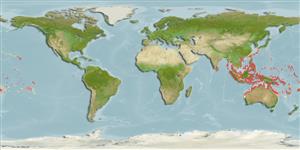
Revassocierade; djupintervall 3 - 20 m (Ref. 8294). Tropical; 36°N - 31°S, 32°E - 137°W (Ref. 847)
Indo-Pacific.
Längd vid första mognad / Storlek / Vikt / Ålder
Könsmognad: Lm ? range ? - ? cm Max length : 30.0 cm COLD hane/ej könsbestämd; (Ref. 269)
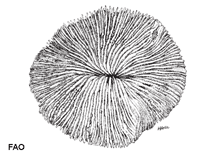
The coral is circular in outline, up to 30 cm in diameter. The upper surface is fairly rough due to moderate to deeply incised septal dentations on most septocostae, and the lower surface is rough due to costal spines (Ref. 269). The coral is circular in outline, up to 30 cm in diameter.
Maximum depth from Ref. 98471. Found at intermediate depths on reef slopes (Ref. 269). Also on back reefs, reef flats, and lagoons. Solitary, free-living (Ref. 98471).
Livscykel och parningsbeteende
Könsmognad | Reproduktion | Lek | Ägg | Fekunditet | Larver
Mature gametes are shed into the coelenteron and spawned through the mouth. Life cycle: The zygote develops into a planktonic planula larva. Metamorphosis begins with early morphogenesis of tentacles, septa and pharynx before larval settlement on the aboral end (Ref. 833).
Hodgson, G. 1998 Corals. p. 101-122. In Carpenter, K.E. and V.H. Niem (eds) FAO species identifidication guide for fishery purposes. The living marine resources of the Western Central Pacific. Vol. 1. Seaweeds, coral, bivalves and gastropods. FAO Rome. (Ref. 269)
Status på IUCN:s rödlista
(Ref. 130435: Version 2025-2 (Global))
CITES-status (Ref. 108899)
Not Evaluated
Hot mot människor
Mänskliga användningsområden
FAO - Publication: search | FishSource |
Verktyg
Ytterligare information
Trofisk ekologiLivsmedelsartiklar (preys)FödosammansättningFödointagPredatorer MänniskorelateradFrimärken, mynt, diverse.
Internet-källor
Uppskattningar baserade på modeller
Sårbarhet i fisket
(Ref. 71543) |
Low vulnerability (20 of 100). |
Priskategori
(Ref. 80766): |
Unknown. |