Hexacorallia |
Scleractinia |
Fungiidae
Miljö: miljö / Klimatzon / djupintervall / distributionsområde
Ekologi
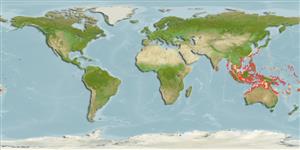
Revassocierade; djupintervall 0 - 40 m (Ref. 847). Tropical; 36°N - 26°S, 32°E - 172°W (Ref. 847)
Indo-West Pacific.
Längd vid första mognad / Storlek / Vikt / Ålder
Könsmognad: Lm ? range ? - ? cm Max length : 100.0 cm TL hane/ej könsbestämd; (Ref. 269)
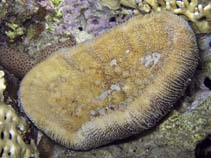
A solitary, free-living species often found in large aggregations at intermediate depths on reef slope benches. The coral is moderately elongate (length to width ratio between 1.5 and 3 to 1) and may reach 1 m in length. Both upper and lower surfaces are very rough due to septal and costal dentations (Ref. 269).
The coral is moderately elongate (length to width ratio between 1.5 and 3 to 1) and may reach 1 m in length (Ref. 269). A solitary, free-living species often found in large aggregations at intermediate depths on reef slope benches (Ref. 269). Also on reef flats (Ref. 98471).
Livscykel och parningsbeteende
Könsmognad | Reproduktion | Lek | Ägg | Fekunditet | Larver
Members of the class Anthozoa are either gonochoric or hermaphroditic. Mature gametes are shed into the coelenteron and spawned through the mouth. Life cycle: The zygote develops into a planktonic planula larva. Metamorphosis begins with early morphogenesis of tentacles, septa and pharynx before larval settlement on the aboral end.
Veron, J.E.N. 2000 Corals of the world. Volume 2. Australian Institute of Marine Science and CRR Qld. Pty. Ltd. Australia. 429 p. (Ref. 847)
Status på IUCN:s rödlista
(Ref. 130435: Version 2025-2 (Global))
CITES-status (Ref. 108899)
Not Evaluated
Hot mot människor
Mänskliga användningsområden
FAO - Publication: search | FishSource |
Verktyg
Ytterligare information
Trofisk ekologiLivsmedelsartiklar (preys)
Födosammansättning
Födointag
Predatorer
PopulationsdynamikTillväxt
Max. åldrar / storlekar
Längd-vikt rel.
Längd-längd rel.
Längd-frekvenser
Massakonvertering
Abundans
LivscykelReproduktionKönsmognadFekunditetLekÄggUtveckling av äggLarver MänniskorelateradFrimärken, mynt, diverse.
Internet-källor
Uppskattningar baserade på modeller
Sårbarhet i fisket
(Ref. 71543) |
High vulnerability (60 of 100). |
Priskategori
(Ref. 80766): |
Unknown. |