Hexacorallia |
Actiniaria |
Actiniidae
Ambiente: milieu / zona climática / intervalo de profundidade / gama de distribuição
Ecologia
Sessile; intervalo de profundidade 5 - 10 m (Ref. 125626). Subtropical
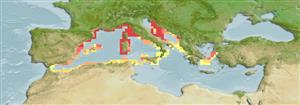
Endemic to the Mediterranean.
Comprimento na primeira maturidade / Tamanho / Peso / Idade
Maturidade: Lm ? range ? - ? cm Max length : 5.0 cm TL macho/indeterminado; (Ref. 358)
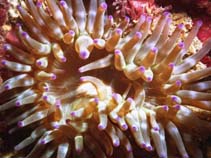
Diameter of the foot: 5.5 cm. Oral disc, without the tentacles: 7.5 cm. 96, laid out in 5 crowns around the siphonoglyphe: Measure up to 5 cm length; they are constant thickness over all their length, being completed in a round point. Oral discs color: gray color with nuances of green or of blue; tentacles also gray; are tinted of brown blue or of brown; each one of them comprising a clearer annular band; and a violet end. Fabrics of the foot of gold color: yellow; with 48 warted lines: each one of these protuberances is of red color, ringed of clearer yellow (Ref. 358).
Primary education and secondary rock funds; anfractuosities, with half inserted with the foot of rocks and sometimes large-sized stones; or when the ground is movable, the foot fixed on remains of shells or stones. Small funds until the greatest depths (Ref. 358). Known from circalittoral zones (Ref. 85338). Solitary (Ref. 2377).
Ciclo de vida e comportamento de acasalamento
Maturidade | Reprodução | Desova | Ovos | Fecundidade | Larvas
Members of the class Anthozoa are either gonochoric or hermaphroditic. Mature gametes are shed into the coelenteron and spawned through the mouth. Life cycle: The zygote develops into a planktonic planula larva. Metamorphosis begins with early morphogenesis of tentacles, septa and pharynx before larval settlement on the aboral end.
Göthel, H. 1992 Guide de la faune sous-marine: La Méditerranée. Invertébrés marins et poissons. Eygen Ulmer GmbH & Co. 318 p. (Ref. 358)
Categoria na Lista Vermelha da IUCN
(Ref. 130435: Version 2025-2 (Global))
Categoria CITES (Ref. 108899)
Not Evaluated
Not Evaluated
Ameaça para o homem
Utilização humana
FAO - Publication: search | FishSource |
Ferramentas
Mais informação
Ecologia TróficaProdutos alimentares (presas)
Composição da dieta
Consumo alimentar
Predadores
Dinâmica das populaçõesCrescimento
Idades / tamanhos máximos
Comprimento-peso rel.
Comprimento-comprimento rel.
Frequência de comprimento
Conversão de massa
Abundância
Ciclo de vidaReproduçãoMaturidadeFecundidadeDesovaOvosDesenvolvimento dos ovosLarvas FisiologiaConsumo de oxigénio
Relacionado com o ser humanoSelos, moedas, diversos.
Fontes da internet
Estimativas baseadas em modelos
Vulnerabilidade da pesca
(Ref. 71543) |
Low vulnerability (10 of 100). |
Categoria de preço
(Ref. 80766): |
Unknown. |