Hexacorallia |
Actiniaria |
Actiniidae
Umwelt: Milieu / Klimazone / Tiefenbereich / Verbreitungsgebiet
Ökologie
Sessile; tiefenbereich 5 - 10 m (Ref. 125626). Subtropical
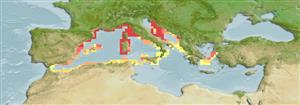
Endemic to the Mediterranean.
Länge bei der ersten Reifung / Größe / Gewicht / Alter
Geschlechtsreife: Lm ? range ? - ? cm Max length : 5.0 cm TL Männchen/unbestimmt; (Ref. 358)
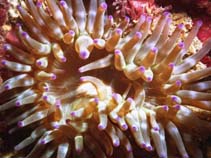
Diameter of the foot: 5.5 cm. Oral disc, without the tentacles: 7.5 cm. 96, laid out in 5 crowns around the siphonoglyphe: Measure up to 5 cm length; they are constant thickness over all their length, being completed in a round point. Oral discs color: gray color with nuances of green or of blue; tentacles also gray; are tinted of brown blue or of brown; each one of them comprising a clearer annular band; and a violet end. Fabrics of the foot of gold color: yellow; with 48 warted lines: each one of these protuberances is of red color, ringed of clearer yellow (Ref. 358).
Primary education and secondary rock funds; anfractuosities, with half inserted with the foot of rocks and sometimes large-sized stones; or when the ground is movable, the foot fixed on remains of shells or stones. Small funds until the greatest depths (Ref. 358). Known from circalittoral zones (Ref. 85338). Solitary (Ref. 2377).
Lebenszyklus und Paarungsverhalten
Geschlechtsreife | Fortpflanzung | Ablaichen | Eier | Fruchtbarkeit | Larven
Members of the class Anthozoa are either gonochoric or hermaphroditic. Mature gametes are shed into the coelenteron and spawned through the mouth. Life cycle: The zygote develops into a planktonic planula larva. Metamorphosis begins with early morphogenesis of tentacles, septa and pharynx before larval settlement on the aboral end.
Göthel, H. 1992 Guide de la faune sous-marine: La Méditerranée. Invertébrés marins et poissons. Eygen Ulmer GmbH & Co. 318 p. (Ref. 358)
IUCN Rote Liste Status
(Ref. 130435: Version 2025-2 (Global))
CITES Status (Ref. 108899)
Not Evaluated
Not Evaluated
Bedrohung für Menschen
Nutzung durch Menschen
FAO - Publication: search | FishSource |
Tools
Mehr Information
Trophische ÖkologieLebensmittel (Beutetiere)
Nahrungszusammensetzung
Nahrungsaufnahme
Räuber
PopulationsdynamikWachstum
Max. Alter/Größen
Länge-Gewicht-Rel.
Länge-Länge-Verhältnis.
Längenhäufigkeiten
Massenkonvertierung
Dichte
LebenszyklusFortpflanzungGeschlechtsreifeFruchtbarkeitAblaichenEierEientwicklungLarven PhysiologieSauerstoffverbrauch
MenschenbezogenBriefmarken, Münzen, Verschiedenes.
Internet Quellen
Schätzungen auf der Grundlage von Modellen
Anfälligkeit der Fischerei
(Ref. 71543) |
Low vulnerability (10 of 100). |
Preiskategorie
(Ref. 80766): |
Unknown. |