-

- About this page
- Languages
-
Feedback
- Citation
- Upload
-
Related species
- Species in
Euphausia - Species in
Euphausiidae - - Classification -
- Euphausiidae
- Euphausiacea
- Malacostraca
- Chordata
- Animalia
- Species in
-



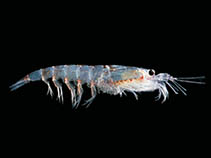
Euphausia superba Dana, 1850
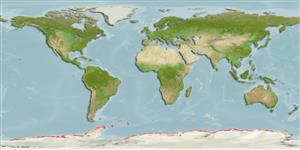
Antarctic krill| Native range | All suitable habitat | Point map | Year 2050 |
|
| This map was computer-generated and has not yet been reviewed. |
| Euphausia superba AquaMaps Data sources: GBIF OBIS |
Classification / Names Common names | Synonyms | CoL | ITIS | WoRMS
Malacostraca | Euphausiacea | Euphausiidae
Environment: milieu / climate zone / depth range / distribution range Ecology
Pelagic; depth range 15 - 130 m (Ref. 111951). Polar, preferred -1°C (Ref. 107945); 46°S - 78°S, 180°W - 180°E
Distribution Countries | FAO areas | Ecosystems | Occurrences | Introductions
Circumpolar in the Southern Ocean.
Length at first maturity / Size / Weight / Age
Maturity: Lm ? range ? - ? cm Max length : 3.0 cm TL male/unsexed; (Ref. 101405)
Found along most of the Antarctic coastline. Adult krill populations' center of distribution is near the continental shelf break, juveniles are found in inshore waters and the eggs and larvae are found in offshore waters (Ref. 96896).
Life cycle and mating behavior Maturity | Reproduction | Spawning | Eggs | Fecundity | Larvae
Main reference
References | Coordinator | Collaborators
Brinton, E. 1962 The distribution of Pacific euphausiids. 8(2), 51-270. In Fox, D.L., Arrhenius, G.O.S., Phleger, F.B. (eds.), Contribution from the Scripps Institution of Oceanography. Bulletin of the Scripps Institution of Oceanography of the Univeristy of California. University of California Press. California. (Ref. 2864)
IUCN Red List Status
(Ref. 130435: Version 2025-1)
Least Concern (LC) ; Date assessed: 12 March 2015
CITES status (Ref. 108899)
Not Evaluated
CMS (Ref. 116361)
Not Evaluated
Threat to humans
Human uses
Fisheries: commercial
FAO - Fisheries: landings, species profile | FIRMS (Stock assessments) | FishSource | Sea Around Us
Tools
More information
Trophic Ecology
Ecology
Population dynamics
Growth
Max. ages / sizes
Length-weight rel.
Length-length rel.
Length-frequencies
Mass conversion
Abundance
Max. ages / sizes
Length-weight rel.
Length-length rel.
Length-frequencies
Mass conversion
Abundance
Life cycle
Reproduction
Maturity
Fecundity
Spawning
Eggs
Egg development
Larvae
Maturity
Fecundity
Spawning
Eggs
Egg development
Larvae
Distribution
Physiology
Oxygen consumption
Human Related
Stamps, coins, misc.
Outreach
Taxonomy
References
Internet sources
BHL | BOLD Systems | CISTI | DiscoverLife | FAO(Fisheries: species profile; publication : search) | Fishipedia | GenBank (genome, nucleotide) | GloBI | Gomexsi | Google Books | Google Scholar | Google | PubMed | Tree of Life | Wikipedia (Go, Search) | Zoological Record
Estimates based on models
Preferred temperature
(Ref. 115969): -1.5 - 1.6, mean 0.2 (based on 535 cells).
Resilience
(Ref. 69278):
High, minimum population doubling time less than 15 months (K=0.43-0.5).
Prior r = 0.51, 95% CL = 0.34 - 0.77, Based on 1 data-limited stock assessment.
Climate Vulnerability
(Ref. 125649):
High vulnerability (58 of 100).
Nutrients : Calcium = 109 [35, 184] mg/100g; Iron = 1.59 [1.21, 1.97] mg/100g; Protein = 20.2 [19.2, 21.3] %; Omega3 = 0.285 [0.185, 0.386] g/100g; Selenium = 48.3 [-31.7, 128.3] μg/100g; VitaminA = 0 μg/100g; Zinc = 1.79 [1.17, 2.40] mg/100g (wet weight); based on nutrient studies.