Malacostraca |
Euphausiacea |
Euphausiidae
Milieu: milieu / Klimaatzone / Diepte / verspreidingsgebied
Ecologie
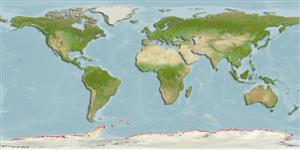
Pelagisch; diepte 0 - 300 m (Ref. 138633), usually 15 - 130 m (Ref. 111951). Polar, preferred -1°C (Ref. 107945); 48°S - 78°S, 180°W - 180°E
Circumpolar in the Southern Ocean: from eastern Ross Sea to the Antarctic Peninsula and Weddell Sea, north to Kerguelen Islands, east to western Ross Sea.
Lengte bij maturiteit / Grootte / Gewicht / Leeftijd
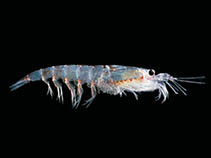
Maturiteit: Lm ? range ? - ? cm Max length : 3.0 cm TL mannelijk / geslacht onbekend; (Ref. 101405)
Minimum depth based from Ref. 111951. Found along most of the Antarctic coastline. Adult krill populations' center of distribution is near the continental shelf break, juveniles are found in inshore waters and the eggs and larvae are found in offshore waters (Ref. 96896).
Levenscyclus en paargedrag
Maturiteit | Voortplanting | Paaien | Eieren | Fecunditeit | Larven
Brinton, E. 1962 The distribution of Pacific euphausiids. 8(2), 51-270. In Fox, D.L., Arrhenius, G.O.S., Phleger, F.B. (eds.), Contribution from the Scripps Institution of Oceanography. Bulletin of the Scripps Institution of Oceanography of the Univeristy of California. University of California Press. California. (Ref. 2864)
Status op de Rode Lijst van het IUCN
(Ref. 130435: Version 2025-2 (Global))
CITES status (Ref. 108899)
Not Evaluated
Not Evaluated
Gevaar voor de mens
Gebruik door de mens
Visserij: commercieel
FAO - visserij: soortsprofiel, landings search; Publication: search | FIRMS (Stock assessments) | FishSource | Sea Around Us
Tools
Meer informatie
LevenscyclusVoortplantingMaturiteitFecunditeitPaaienEierenOntwikkeling van de eierenLarven FysiologieZuurstofverbruik
Menselijk gerelateerdPostzegels, munten, diversen.
Internetbronnen
Schattingen op basis van modellen
Weerstandsvermogen
(Ref. 69278): |
Hoog, minimale populatieverdubbelingstijd minder dan 15 maanden (K=0.43-0.5) |
Rate of population increase
|
Prior r = 0.51, 95% CL = 0.34 - 0.77, Based on 1 data-limited stock assessment. |
Kwetsbaarheid van de visserij
(Ref. 71543) |
Low to moderate vulnerability (28 of 100). |
Kwetsbaarheid voor het klimaat
(Ref. 125649) |
High vulnerability (58 of 100) |
Prijsklasse
(Ref. 80766): |
High. |
Nutrients
|
Calcium = 109 [35, 184] mg/100g; Iron = 1.59 [1.21, 1.97] mg/100g; Protein = 20.2 [19.2, 21.3] %; Omega3 = 0.285 [0.185, 0.386] g/100g; Selenium = 48.3 [-31.7, 128.3] μg/100g; VitaminA = 0 μg/100g; Zinc = 1.79 [1.17, 2.40] mg/100g (wet weight); based on nutrient studies. |