Malacostraca |
Decapoda |
Homolidae
Lingkungan: lingkungan / zona iklim / kisaran kedalaman / jangkauan distribusi
Ekologi
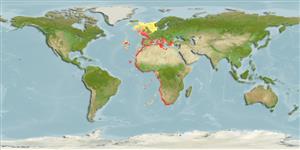
Benthic; kisaran kedalaman 10 - 1212 m (Acuan 435), usually 80 - 350 m (Acuan 435). Temperate; 64°N - 36°S, 34°W - 29°E
Eastern Atlantic and the Mediterranean: from Morocco to Angola and off lying islands, northwards to Hebrides and Southwest Norway, also in Mediterranean as far as Greece.
Panjang pada saat jatuh tempo pertama / Ukuran / Berat / umur
Kematangan: Lm 7.2 range ? - ? cm Max length : 21.5 cm CL jantan/; (Acuan 435)
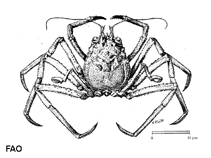
Maximum depth from Ref. 106053. In bathyal oceanic communities (Ref. 96584). Occurs at depths from 10 to 1000 m, common at depths of 80 to 350 m (Ref. 435). Deep-water species, recorded down to 1212 m. Found in the shelf (Ref. 105470), upper and middle slope (Ref. 96584). where it is abundant in the latter (Ref. 96584). Prefers intermixed bathyal mud and emerging rocky substrates. Reported to be among cold-water coral community, specifically on coral mounds and coral habitats on muddy bottoms (Ref. 96584). Also found on seamounts (Ref. 122979). Carries a sponge on its back with its fifth pereiopods. Predator of benthic decapods (Ref. 96584) and an active scavenger (Refs. 96584, 106053).
Members of the order Decapoda are mostly gonochoric. Mating behavior: Precopulatory courtship ritual is common (through olfactory and tactile cues); usually indirect sperm transfer.
rujukan utama
Acuan | Koordinator | mitra
Fischer, W., G. Bianchi and W.B. Scott (eds.) 1981 True Crabs. 6: pag.var. In FAO species identification sheets for fishery purposes. Eastern Central Atlantic (fishing areas 34, 47; in part). Canada Funds-in-Trust. Ottawa, Department of Fisheries and Oceans Canada, by arrangement with the Food and AgriculturesOrganization of the United Nations, 1-7: pag.var. (Acuan 435)
Status IUCN Red List
(Acuan 130435: Version 2025-2 (Global))
status CITES (Acuan 108899)
Not Evaluated
Not Evaluated
ancaman kepada manusia
penggunaan manusia
Perikanan: komersial
FAO - Publication: search | FishSource |
Alat, peralatan
informasi lanjut
FisiologiKonsumsi oksigen
Yang berhubungan dengan manusiaPerangko, koin, dll.
Sumber internet
Estimasi berdasarkan model
Daya lenting
(Ref. 69278): |
Tinggi, Waktu penggandaan populasi minimum kurang dari 15 bulan (Fec=217,000) |
Kerentanan Penangkapan Ikan
(Acuan 71543) |
Low vulnerability (12 of 100). |
kategori harga
(Acuan 80766): |
Unknown. |