Malacostraca |
Decapoda |
Upogebiidae
Meio ambiente: milieu / Zona climática / intervalo de profundidade / faixa de distribuição
Ecologia
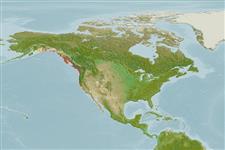
Benthic; estuarina; intervalo de profundidade 0 - 1 m (Ref. 4). Temperate, preferred 9°C (Ref. 107945); 62°N - 35°N, 152°W - 120°W (Ref. 4)
Eastern Pacific: Prince William Sound, Alaska to Morro Bay, California, USA.
Comprimento de primeira maturação / Tamanho / Peso / Idade
Maturidade: Lm ? range ? - ? cm Max length : 15.0 cm TL macho/indeterminado; (Ref. 4); 10.5 cm TL (female)
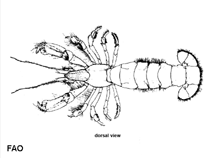
Rostrum ending in three teeth, the median tooth broad and triangular, the lateral teeth much shorter. A groove between the median and lateral teeth, also a very shallow median longitudinal groove. Lower surface of rostrum without spines. Anterolateral border of carapace with a very small tooth at the level of the eye. First pereiopods subchelate. Dactylus of adult male on inner surface with a longitudinal row of 6-12 tubercles, that are placed close together. Carpus with some anterior spines. Merus with a subdistal anterodorsal spine (Ref. 4).
It has lengths of 11 cm, total body length (Ref. 259); 15 cm (males) and 10.5 cm (females), total length (Refs. 4, 258). It burrows in muddy sand of the intertidal zone, sometimes under rocks; burrows are Y-shaped, and about 0.6 to 1 m deep (Ref. 4). Found in bays and estuaries (Ref. 112892).
Ciclo de vida ou comportamento de acasalamento
Maturidade | Reprodução | Desova | Ovos | Fecundidade | Larvas
Members of the order Decapoda are mostly gonochoric. Mating behavior: Precopulatory courtship ritual is common (through olfactory and tactile cues); usually indirect sperm transfer.
Holthuis, L.B. 1991 FAO Species Catalogue. Vol. 13. Marine lobsters of the world. An annotated and illustrated catalogue of species of interest to fisheries known to date. FAO Fish. Synop. 125(13):292p. Rome: FAO. (Ref. 4)
Status na Lista Vermelha da UICN
(Ref. 130435: Version 2025-2 (Global))
Status no CITES (Ref. 108899)
Not Evaluated
Not Evaluated
Ameaça para os humanos
Uso pelos humanos
Pescarias: espécies comerciais; isca: occasionally
FAO - pescarias: landings search; Publication: search | FishSource | Sea Around Us
Ferramentas
Mais informação
Dinâmica populacionalCrescimento
Idade máxima / tamanhos
Relação comprimento-peso.
Relação comprimento-comprimento.
Frequências de comprimento
Conversão de massa
Abundância
Relacionado a humanosSelos, moedas, diversos.
Fontes da internet
Estimativas baseadas em modelos
Vulnerabilidade da pesca
(Ref. 71543) |
Low vulnerability (10 of 100). |
Vulnerabilidade climática
(Ref. 125649) |
High to very high vulnerability (71 of 100) |
Categoria de preço
(Ref. 80766): |
Very high. |
Nutrients
|
Calcium = 109 [35, 184] mg/100g; Iron = 1.59 [1.21, 1.97] mg/100g; Protein = 20.2 [19.2, 21.3] %; Omega3 = 0.285 [0.185, 0.386] g/100g; Selenium = 48.3 [-31.7, 128.3] μg/100g; VitaminA = 0 μg/100g; Zinc = 1.79 [1.17, 2.40] mg/100g (wet weight); based on nutrient studies. |