Malacostraca |
Decapoda |
Upogebiidae
Lingkungan: lingkungan / zona iklim / kisaran kedalaman / jangkauan distribusi
Ekologi
Benthic; payau; kisaran kedalaman 0 - 1 m (Acuan 4). Temperate, preferred 9°C (Acuan 107945); 62°N - 35°N, 152°W - 120°W (Acuan 4)
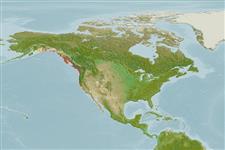
Eastern Pacific: Prince William Sound, Alaska to Morro Bay, California, USA.
Panjang pada saat jatuh tempo pertama / Ukuran / Berat / umur
Kematangan: Lm ? range ? - ? cm Max length : 15.0 cm TL jantan/; (Acuan 4); 10.5 cm TL (female)
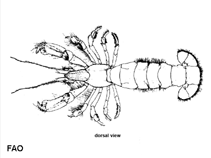
Rostrum ending in three teeth, the median tooth broad and triangular, the lateral teeth much shorter. A groove between the median and lateral teeth, also a very shallow median longitudinal groove. Lower surface of rostrum without spines. Anterolateral border of carapace with a very small tooth at the level of the eye. First pereiopods subchelate. Dactylus of adult male on inner surface with a longitudinal row of 6-12 tubercles, that are placed close together. Carpus with some anterior spines. Merus with a subdistal anterodorsal spine (Ref. 4).
It has lengths of 11 cm, total body length (Ref. 259); 15 cm (males) and 10.5 cm (females), total length (Refs. 4, 258). It burrows in muddy sand of the intertidal zone, sometimes under rocks; burrows are Y-shaped, and about 0.6 to 1 m deep (Ref. 4). Found in bays and estuaries (Ref. 112892).
Members of the order Decapoda are mostly gonochoric. Mating behavior: Precopulatory courtship ritual is common (through olfactory and tactile cues); usually indirect sperm transfer.
rujukan utama
Acuan | Koordinator | mitra
Holthuis, L.B. 1991 FAO Species Catalogue. Vol. 13. Marine lobsters of the world. An annotated and illustrated catalogue of species of interest to fisheries known to date. FAO Fish. Synop. 125(13):292p. Rome: FAO. (Acuan 4)
Status IUCN Red List
(Acuan 130435: Version 2025-2 (Global))
status CITES (Acuan 108899)
Not Evaluated
Not Evaluated
ancaman kepada manusia
penggunaan manusia
Perikanan: komersial; umpan: occasionally
FAO - Perikanan: landings search; Publication: search | FishSource | Laut di Sekitar Kita
Alat, peralatan
informasi lanjut
Dinamika populasiPertumbuhan
Maks. usia / ukuran
Panjang-berat rel.
Panjang-panjang rel.
ukuran frekuensi
Konversi massa
Kelimpahan
Yang berhubungan dengan manusiaPerangko, koin, dll.
Sumber internet
Estimasi berdasarkan model
Kerentanan Penangkapan Ikan
(Acuan 71543) |
Low vulnerability (10 of 100). |
Kerentanan Iklim
(Acuan 125649) |
High to very high vulnerability (71 of 100) |
kategori harga
(Acuan 80766): |
Very high. |
Nutrients
|
Calcium = 109 [35, 184] mg/100g; Iron = 1.59 [1.21, 1.97] mg/100g; Protein = 20.2 [19.2, 21.3] %; Omega3 = 0.285 [0.185, 0.386] g/100g; Selenium = 48.3 [-31.7, 128.3] μg/100g; VitaminA = 0 μg/100g; Zinc = 1.79 [1.17, 2.40] mg/100g (wet weight); based on nutrient studies. |