Malacostraca |
Decapoda |
Palinuridae
Umwelt: Milieu / Klimazone / Tiefenbereich / Verbreitungsgebiet
Ökologie
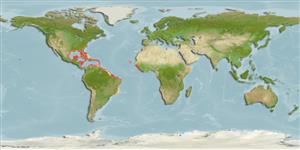
Benthic; tiefenbereich 0 - 90 m (Ref. 441). Tropical, preferred 27°C (Ref. 107945); 35°N - 24°S, 97°W - 11°E (Ref. 4)
Atlantic Ocean.
Länge bei der ersten Reifung / Größe / Gewicht / Alter
Geschlechtsreife: Lm 8.3, range 7 - 8.1 cm Max length : 45.0 cm TL Männchen/unbestimmt; (Ref. 4); common length : 20.0 cm TL Männchen/unbestimmt; (Ref. 4); max. veröff. Alter: 15 Jahre (Ref. 129472)
Longevity from Ref. 472'>129472 (Supplementary material). Occurs at depths down to 90 m, perhaps even deeper; usually inhabits shallow waters and found among rocks, on reefs, eelgrass beds or in any habitat that provides protection. The species is gregarious and migratory. Females move to deeper water for spawning and there are mass migrations in the autumn when the animals, in single files up to 50 individuals, move in a certain direction in daytime, each animal having body contact with the next through the antennae; In the northern part of its range, larvae are found mainly from June to December (Ref. 4).
Females move to deeper water for spawning and there are mass migrations in the autumn when the animals, in single files up to 50 individuals, move in a certain direction in daytime, each animal having body contact with the next through the antennae; In the northern part of its range, larvae are found mainly from June to December (Ref. 4).
Holthuis, L.B. 1991 FAO Species Catalogue. Vol. 13. Marine lobsters of the world. An annotated and illustrated catalogue of species of interest to fisheries known to date. FAO Fish. Synop. 125(13):292p. Rome: FAO. (Ref. 4)
IUCN Rote Liste Status
(Ref. 130435: Version 2025-2 (Global))
CITES Status (Ref. 108899)
Not Evaluated
Not Evaluated
Bedrohung für Menschen
Nutzung durch Menschen
Fischereien: kommerziell
FAO - Fischereien: Artbeschreibung, landings search; Publication: search | FIRMS (Stock assessments) | FishSource | Das Meer um uns herum
Tools
Mehr Information
PhysiologieSauerstoffverbrauch
MenschenbezogenBriefmarken, Münzen, Verschiedenes.
Internet Quellen
Schätzungen auf der Grundlage von Modellen
Widerstandsfähigkeit
(Ref. 69278): |
mittel, Verdopplung der Population dauert 1,4 - 4,4 Jahre. (K=0.16-0.39; tm=4) |
Rate of population increase
|
Prior r = 0.82, 95% CL = 0.54 - 1.23, Based on 1 full stock assessment. |
Anfälligkeit der Fischerei
(Ref. 71543) |
Moderate vulnerability (42 of 100). |
Klimaanfälligkeit
(Ref. 125649) |
High to very high vulnerability (66 of 100) |
Preiskategorie
(Ref. 80766): |
Very high. |
Nutrients
|
Calcium = 109 [35, 184] mg/100g; Iron = 1.59 [1.21, 1.97] mg/100g; Protein = 20.2 [19.2, 21.3] %; Omega3 = 0.285 [0.185, 0.386] g/100g; Selenium = 48.3 [-31.7, 128.3] μg/100g; VitaminA = 0 μg/100g; Zinc = 1.79 [1.17, 2.40] mg/100g (wet weight); based on nutrient studies. |