Malacostraca |
Decapoda |
Sergestidae
สิ่งแวดล้อม : สิ่งแวดล้อม / เขตภูมิอากาศ / ระดับความลึก / ระยะการกระจายสินค้า
นิเวศวิทยา
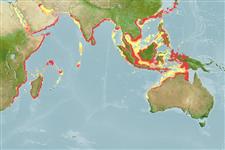
กลุ่มสัตว์หน้าดิน,กลุ่มสัตว์พื้นท้องน้ำ; กร่อย; ระดับความลึก 0 - 55 m (อ้างอิง 409). Tropical; 31°N - 32°S, 30°E - 138°E
Indo-West Pacific: Eastern Africa to Hong Kong and Australia.
ความยาวเมื่อครบกำหนดครั้งแรก / ขนาด / น้ำหนัก / อายุ
วัยเจริญพันธุ์: Lm ? range ? - ? cm Max length : 3.2 cm BL เพศผู้/กระเทย; (อ้างอิง 409); 4.8 cm BL (female)
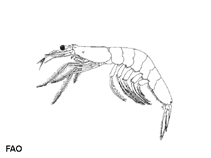
Rostrum, which has two dorsal denticles or teeth, is shorter than eyes. Elongated first 3 pereiopods and no fourth and fifth pereiopods. Larger female than males. Color: in life, whole body almost transparent. Milky or yellowish when dead.
Marketed either dried, boiled, salted, fermented, fresh, or processed in other ways; consumed locally in the form of seasoning (shrimp paste/sauce) (Ref. 409). Planktonic in life. Inhabits estuarine waters with mangroves (Ref. 374). Marine or brackish, but usually brackish and fished in the intertidal zone, estuaries (Ref. 409) and mangroves (Refs. 409, 121475). In general, it is a zooplanktivorous omnivore, wherein it primarily feeds on copepods, ostracods, other crustaceans, and molluscan veligers. It is observed to forage intensively after midnight (Ref. 104021). Omnivorous suspension feeder (Ref. 105380).
วงจรชีวิตและพฤติกรรมการผสมพันธุ์
วัยเจริญพันธุ์ | การสืบพันธุ์ | การวางไข่ | เซลสืบพันธ์ของเพศเมีย(ไข่) | ความดกของไข่ | ตัวอ่อน
Members of the order Decapoda are mostly gonochoric. Mating behavior: Precopulatory courtship ritual is common (through olfactory and tactile cues); usually indirect sperm transfer.
Pérez Farfante, I. and B. Kensley 1997 Penaeoid and Sergestoid shrimps and prawns of the world: keys and diagnoses for the families and genera. Mémoires du Muséum National d'Histoire Naturelle 175:1-233. (อ้างอิง 75620)
สถานะบัญชีแดงของ IUCN
(อ้างอิง 130435: Version 2025-2 (Global))
สถานะไซเตส (อ้างอิง 108899)
Not Evaluated
CMS (อ้างอิง 116361)
Not Evaluated
ภัยคุกคามต่อมนุษย์
การใช้ของมนุษย์
การประมง: การค้า
FAO - การประมง: landings search; Publication: search | FishSource |
เครื่องมือ
ข้อมูลเพิ่มเติม
วงจรชีวิตการสืบพันธุ์วัยเจริญพันธุ์ความดกของไข่การวางไข่เซลสืบพันธ์ของเพศเมีย(ไข่)การพัฒนาไข่ตัวอ่อน เกี่ยวข้องกับมนุษย์แสตมป์ เหรียญ อื่นๆ
แหล่งที่มาจากอินเตอร์เน็ต
การประมาณค่าตามแบบจำลอง
ความสามารถในการกลับคืนสู่ปกติ
(Ref. 69278): |
ความสูง, เวลาต่ำสุดที่จะทำให้ประชากรเพิ่มขึ้นเป็น 2 เท่าใช้เวลาน้อยกว่า 15 เดือน (K=1.2) |
ความเสี่ยงต่อการตกปลา
(อ้างอิง 71543) |
Low vulnerability (10 of 100). |
หมวดหมู่ราคา
(อ้างอิง 80766): |
Very high. |