Malacostraca |
Decapoda |
Sergestidae
Lingkungan: lingkungan / zona iklim / kisaran kedalaman / jangkauan distribusi
Ekologi
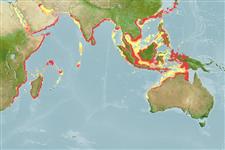
Bentopelagis; payau; kisaran kedalaman 0 - 55 m (Acuan 409). Tropical; 31°N - 32°S, 30°E - 138°E
Indo-West Pacific: Eastern Africa to Hong Kong and Australia.
Panjang pada saat jatuh tempo pertama / Ukuran / Berat / umur
Kematangan: Lm ? range ? - ? cm Max length : 3.2 cm BL jantan/; (Acuan 409); 4.8 cm BL (female)
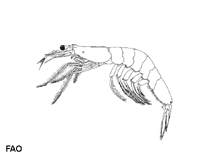
Rostrum, which has two dorsal denticles or teeth, is shorter than eyes. Elongated first 3 pereiopods and no fourth and fifth pereiopods. Larger female than males. Color: in life, whole body almost transparent. Milky or yellowish when dead.
Marketed either dried, boiled, salted, fermented, fresh, or processed in other ways; consumed locally in the form of seasoning (shrimp paste/sauce) (Ref. 409). Planktonic in life. Inhabits estuarine waters with mangroves (Ref. 374). Marine or brackish, but usually brackish and fished in the intertidal zone, estuaries (Ref. 409) and mangroves (Refs. 409, 121475). In general, it is a zooplanktivorous omnivore, wherein it primarily feeds on copepods, ostracods, other crustaceans, and molluscan veligers. It is observed to forage intensively after midnight (Ref. 104021). Omnivorous suspension feeder (Ref. 105380).
Siklus hidup dan perilaku kawin
Kematangan | Reproduksi, perkembang biakan | Pemijahan | telur-telur | Fekunditas | Larva
Members of the order Decapoda are mostly gonochoric. Mating behavior: Precopulatory courtship ritual is common (through olfactory and tactile cues); usually indirect sperm transfer.
rujukan utama
Acuan | Koordinator | mitra
Pérez Farfante, I. and B. Kensley 1997 Penaeoid and Sergestoid shrimps and prawns of the world: keys and diagnoses for the families and genera. Mémoires du Muséum National d'Histoire Naturelle 175:1-233. (Acuan 75620)
Status IUCN Red List
(Acuan 130435: Version 2025-2 (Global))
status CITES (Acuan 108899)
Not Evaluated
Not Evaluated
ancaman kepada manusia
penggunaan manusia
Perikanan: komersial
FAO - Perikanan: landings search; Publication: search | FishSource |
Alat, peralatan
informasi lanjut
FisiologiKonsumsi oksigen
Yang berhubungan dengan manusiaPerangko, koin, dll.
Sumber internet
Estimasi berdasarkan model
Daya lenting
(Ref. 69278): |
Tinggi, Waktu penggandaan populasi minimum kurang dari 15 bulan (K=1.2) |
Kerentanan Penangkapan Ikan
(Acuan 71543) |
Low vulnerability (10 of 100). |
kategori harga
(Acuan 80766): |
Very high. |