Malacostraca |
Decapoda |
Penaeidae
Ambiente: milieu / zona climatica / distribuzione batimetrica / gamma di distribuzione
Ecologia
Benthic; salmastro; distribuzione batimetrica 2 - 300 m (Fonte Biblio. 8), usually ? - 60 m (Fonte Biblio. 10). Tropical, preferred 27°C (Fonte Biblio. 107945)
Indo-West Pacific and the Mediterranean.
Lunghezza alla prima maturità / Dimensione / Peso / Età
Maturità: Lm 10.4, range 2 - 2.4 cm Max length : 21.5 cm TL maschio/sesso non determinato; (Fonte Biblio. 119750); 26 cm TL (female); peso massimo pubblicato: 130.00 g (Fonte Biblio. 374)
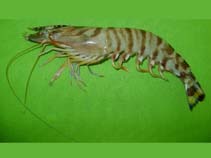
Carapace and abdomen uniformly glabrous. More or less straight rostrum armed with 7 or 8 dorsal and 3 ventral teeth. Inclined downward and anteriorly hepatic carina. White and red transverse stripes present as bands in the antennae. Adrostral carina reaching well beyond epigastric tooth.
Maximum depth from Ref. 801'>801. Occurs on mud, sandy-mud or sandy-grit substrates (Ref. 10), seagrass, mangrove and among shells (Ref. 121467). Prefers marine (adults) and estuarine (juveniles) environments in subtropical and tropical climates (Ref. 8). Forms small shoals. Predominantly nocturnal and buries in substrate during day time (Ref. 10). Postlarvae settle exclusively in seagrass beds (Ref. 84594); Juveniles also seek refuge in seagrass beds (Ref. 106924). Feeds on seagrass (Ref. 84594), diatoms, algae, (Ref. 104907), bivalves, gastropods, ophiuroids, crustaceans and polychaetes (Ref. 104903).
Mating behavior: Precopulatory courtship ritual is common (through olfactory and tactile cues); usually indirect sperm transfer (Ref. 833).
Holthuis, L.B. 1980 FAO Species Catalogue. Vol. 1. Shrimps and prawns of the world. An annotated catalogue of species of interest to fisheries. FAO Fish. Synop. 125(1):271 p. Rome: FAO. (Fonte Biblio. 8)
Stato della Lista Rossa IUCN
(Fonte Biblio. 130435: Version 2025-2 (Global))
Stato della CITES (Fonte Biblio. 108899)
Not Evaluated
CMS (Fonte Biblio. 116361)
Not Evaluated
Minaccia per l'uomo
Usi umani
Pesca: commerciale
FAO - Aquaculture Systems: production searchpesca: profilo della specie, landings search; Publication: search | FishSource | Sea Around Us
Strumenti
Informazioni ulteriori
Dinamica della popolazione FisiologiaConsumo di ossigeno
Legato all'uomoFrancobolli, monete, materiale vario.
Fonti Internet
Stime basate su modelli
Resilienza
(Ref. 69278): |
Alto, tempo minimo di raddoppiamento della popolazione meno di 15 mesi (K=1.6; tm=1.8) |
Rate of population increase
|
Prior r = 1.18, 95% CL = 0.78 - 1.77, Based on 1 data-limited stock assessment. |
Vulnerabilità della pesca
(Fonte Biblio. 71543) |
Low vulnerability (14 of 100). |
Vulnerabilità climatica
(Fonte Biblio. 125649) |
Low to moderate vulnerability (28 of 100) |
Categoria di prezzo
(Fonte Biblio. 80766): |
Very high. |
Nutrients
|
Calcium = 109 [35, 184] mg/100g; Iron = 1.59 [1.21, 1.97] mg/100g; Protein = 20.2 [19.2, 21.3] %; Omega3 = 0.285 [0.185, 0.386] g/100g; Selenium = 48.3 [-31.7, 128.3] μg/100g; VitaminA = 0 μg/100g; Zinc = 1.79 [1.17, 2.40] mg/100g (wet weight); based on nutrient studies. |