Malacostraca |
Decapoda |
Palaemonidae
Milieu: milieu / Klimaatzone / Diepte / verspreidingsgebied
Ecologie
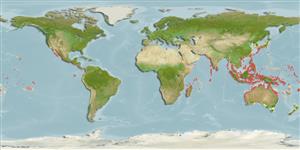
Rifbewoner; diepte 1 - 15 m (Ref. 113378). Tropical
Indo-Pacific: Mozambique to Japan, Australia and Papua New Guinea.
Lengte bij maturiteit / Grootte / Gewicht / Leeftijd
Maturiteit: Lm ? range ? - ? cm
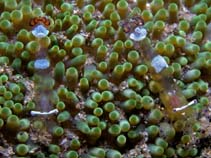
Body is transparent with large white spots. Four to five orange spots with a black ring are present on the tail fan. Purplish-blue rings are present near the joints and tips of pereiopods. Rostrum well-developed, with five to six dorsal, and two ventral teeth. Females are generally larger.
Minimum depth from Ref. 83472. Epizoic, Intertidal to subtidal (Ref. 106854). Associated with giant anemones (Ref. 113378). Usually found in pairs. Occasionally found on hard corals (Ref. 125532).
Levenscyclus en paargedrag
Maturiteit | Voortplanting | Paaien | Eieren | Fecunditeit | Larven
Members of the order Decapoda are mostly gonochoric. Mating behavior: Precopulatory courtship ritual is common (through olfactory and tactile cues); usually indirect sperm transfer.
Bruce, A.J. 2005 Pontoniine shrimps from Papua New Guinea, with designation of two new genera, Cainonia and Colemonia (Crustacea: Decapoda: Palaemonidae). Memoirs of the Queensland Museum 51(2):333-383. (Ref. 83471)
Status op de Rode Lijst van het IUCN
(Ref. 130435: Version 2025-2 (Global))
CITES status (Ref. 108899)
Not Evaluated
Not Evaluated
Gevaar voor de mens
Gebruik door de mens
FAO - Publication: search | FishSource |
Tools
Meer informatie
Trofische ecologieVoedsel (prooien)
Dieetsamenstelling
Voedselconsumptie
Predatoren
PopulatiedynamicaGroei
Max. leeftijden / maten
Lengte-gewicht rel.
Lengte-lengte rel.
Lengtefrequenties
Massaconversie
Abundantie
LevenscyclusVoortplantingMaturiteitFecunditeitPaaienEierenOntwikkeling van de eierenLarven FysiologieZuurstofverbruik
Menselijk gerelateerdPostzegels, munten, diversen.
Internetbronnen
Schattingen op basis van modellen